Gnarr Take Two

I washed and am currently blocking the swatches. Then I realised that I couldn’t retake the swatch photos, because the swatches are currently pinned with blocking sticks to a Styrofoam block.

This is so not my day.

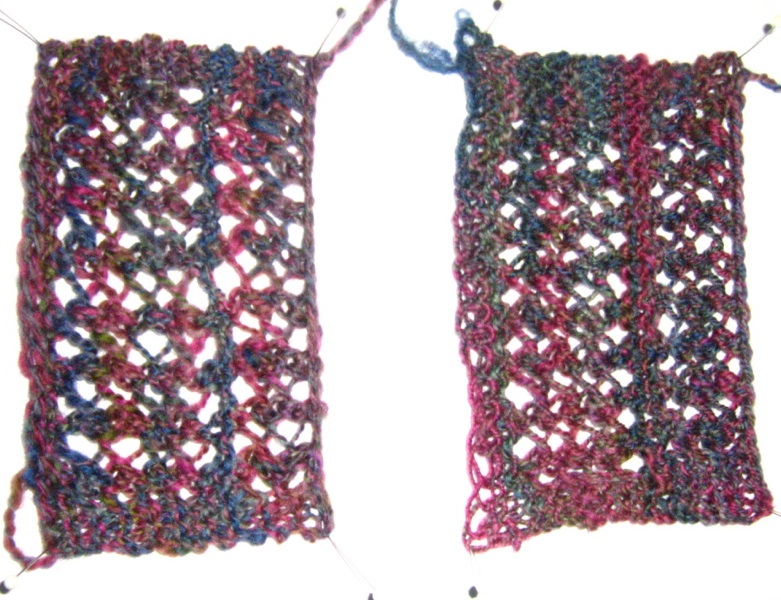
OTOH, the n-ply swatch seems to have softened up. The two-ply hasn’t really redistributed its unevenness as much as I’d hoped, though; it really is an issue of thick/thin yarn. (I apologise for the orange towel. It’s the current scrap towel in the bathroom and so was what I had at hand when the swatches were rinsed and needed to be dried.)

That’s the two-ply on the left and the n-ply on the right. The border on the n-ply looks a bit cockeyed because I was knitting three stitches on one side and four on the other, and I switched them accidentally after the rows of straight knit stitch in the middle. So it’s thicker on the upper left and lower right. Not a true reflection of how the border will look in the finished product, because I’ll be doing the full stitch count and won’t be having to make up numbers on the fly. (I did learn, and subtracted a stitch from my cast-on for the two-ply sample, which is why the borders at the top and bottom are even.)

I really don’t know. The n-ply looks crisper and the pattern is really textured. The two-ply looks softer and the pattern is somewhat blurred. They’re about the same to touch.

While the swatches dry completely, this is as good a place as any to paste this reply I recently made in a Ravelry forum. Someone was prepping a fibre arts presentation for classmates in a fine arts program, and was collecting answers for the inevitable question of, “Why bother spinning when you can just go the store and buy yarn?”

As others have said, it’s a tactile thing for me. Soft, pretty fibre feels so good on my hands. It’s also very meditative. I can sit down to spin and disengage the monkey-chatter of my mind, focusing solely on the feel of the fibre in my fingers, the tension between my hands and the fibre as I draft, the slide as the drafting pulls the staples along one another, and the draw of the wheel. But it’s also pleasing on a sensory level in other ways, too: I love the rhythm my foot, hands, and body get into. I love the mellow glowing stain I used to finish my wheel. I love seeing how the colours of my fibre blend as they move from the drafting triangle and begin to twist together, and I love seeing how the tones and hues of the new single wrap around the core of my bobbin. I even love the whooshing sound the wheel makes (just not the squeak that develops as the orifice spins in the cup until I dab a bit of Vaseline on it).

I’m not much of a knitter, so while I’m currently working on a specific yarn to use for a project, that’s not really part of my thing. I spin for others, though.

And yes, there is a large dose of “I made something useful out of fluff!” as well as “I made something beautiful!” that goes along with loving the process.

Gnarr

This morning I am on a homicidal rampage against HP.

When I got the Mac my printer worked, yay (unlike my previous Windows PCs where I had to install sixty trillion things to get my peripherals to work); no need to install all the HP software that takes up huge amounts of space and that I don’t use. And then I said to someone I’d scan and e-mail them a printed photo. For some reason, that didn’t work at all. The printer says it isn’t connected to the computer when I try to initiate the scan from it; the printer says there’s no scanner hooked up when I try to go at it the other way around. This is hunh?-worthy, because my printer is an all-in-one unit, so if the printer is connected and works, then the scanner is also connected and should work. So last week I finally downloaded the Mac software from HP and installed it. The scan worked. And then the computer froze upon reboot the next morning. But since then there hasn’t been a problem, not that I’ve tried another scan.

Till this morning, when HRH asked me to scan and send an image to him at work.

Nothing works. Nothing. I tried going at it from sixteen different directions. I tried uninstalling and reinstalling four times; now the software and drivers won’t even install without crashing. I downloaded non-HP software that claims it works with my scanner; it doesn’t recognize it.

My research online tells me that an awful lot of people using Macs have the same problem with HP printers of all models and types, despite HP claiming to be fully Mac-compatible. Apparently HP is dreadful in general with their drivers, but even more so with Macs.

Gods-damned HP. Why do I keep buying their products? Why? (Because they’re cheap. And I’m paying for it in other ways.)

This means I may need to need to buy or acquire a third printer within four years. I am not pleased. Although HP was so ashamed of the bashlash they experienced upon the release of Snow Leopard because they’d utterly failed to match the upgrade (they actually told people to buy new printers instead!) that they decided that it would be a good move to develop Snow Leopard-compatible drivers after all, and finally made sure the scanner part of the all-in-one units like the one I have would actually be supported, after ages of ignoring them in the driver updates. So if I upgrade to Snow Leopard, the printer and scanner should work. This is worth thinking about, as Snow Leopard is only $35 and by all reports is very shiny and exciting. Still; I shouldn’t have to upgrade my OS from a perfectly functional release to get my scanner to work. HP should be releasing fully functional updated drivers concurrent with every previous OS upgrade instead of crippled ones that only address one of the functions in an all-in-one.

I can’t even spin to relax because I don’t have spare bobbins, and I can’t go ahead and ply the stuff I’ve got because I still don’t know if I’m using the n-ply or the two-ply for Devon’s wrap.

I had Girl Guide cookies for breakfast. I suspect I’m going to make chocolate chip shortbread cookies very soon, and probably focaccia for lunch. Also, if it’s going to go up to 14 today, would the sun please come out?

rawr rawr rawr. and grump.

Maybe I’ll retake all those awful swatch photos while listening to decent music. I’m not calm enough to open my new freelance assignment and work on it just yet.

Swatch #2 With Two-Ply Handspun

One and a half repeats, half-width swatch of the pattern for my eldest goddaughter’s Yule gift, a convertible wrap/scarf/capelet/hood, knit with the two-ply sample of my own handspun yarn:

To my surprise, the difference in softness isn’t as drastic as I thought it would be. Yes, the two-ply is softer than the Navajo-plied yarn I used on the first swatch, but it’s not the absolute deal-breaker I expected. It will be a factor, though. What is astonishing is the difference in stitch definition. The n-ply is so much more crisp and even. The two-ply has the thick-thin yarn thing going on; it isn’t as evenly plied as the n-ply, and so the pattern sort of bubbles in places. Now, theoretically this is the sort of thing that could adjusted with blocking, which we will try next.

Also, the swatch knitted with the Navajo-plied yarn has more body and integrity. The sample knit with the two-ply drapes a bit more. This is what produces the degree of stitch definition, I suppose. I’m not too worried about the wrap being too stuff, as it’s going to be bigger and the weight will make it flow more than the small swatch does.

(I see that despite my notes, I did twice the amount of garter stitch on the n-plied sample than the two-ply. That’s why the bar of non-lace stitch in the middle looks different.)

A photo of both. The two-ply swatch is on the left, the Navajo-plied swatch is on the right:

If I had to decide between the two samples right now, I think I’d go with the Navajo-ply, because the two-ply swatch just looks… messy. But I’ll wash and block the swatches properly, and we’ll see what happens to the pattern once they’re dry.

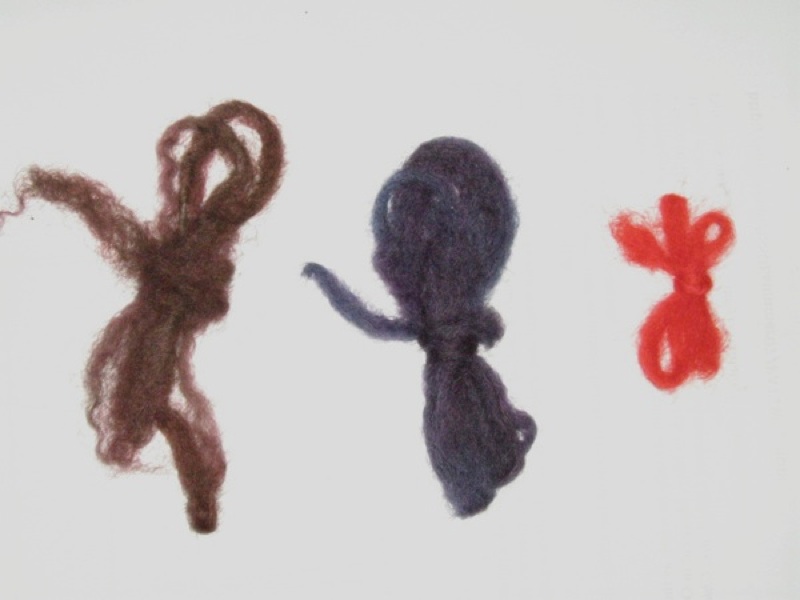
And in other mostly unconnected news, I messed with red and purple dye today. Displeased with the violet dye alone, I mixed it with a bit of brown and got an old red wine colour (not the dried blood colour the picture suggests), and blended my own purple from equal parts of red and blue (more of a grape-popsicle colour than what’s here). The red on its own was a control experiment, as I hadn’t tried it yet. The fibre was natural BFL scraps.

(I’m hating my photos lately.)

Weekend Roundup

My fibre arts stuff is detailed elsewhere, so this will be brief:

Saturday:
AM: Awful cello lesson. It’s been a while since I almost broke into tears. I’m at the I-can’t-do-anything-and-I-don’t-understand-why point.

PM: Shopping: Errand-running after the boy’s nap, mostly for Hallowe’en related itemry. We get a turtleneck and tights for the boy’s Superman costume (pattern plus fabric = more expensive). No rainboots, but we do buy him a new pair of winter boots he needs (size 11, yikes).

Night: I finish my green lace scarf after much hair-tearing, rending of clothes, and gnashing of teeth.

Sunday:
AM: Another shopping run. I become very annoyed when the kitchen scale on half-price at Zellers is nowhere to be found in the store. We do the groceries, then head out to the farm stand on the south shore to pick up our pumpkins and a whack of veggies. The farmer slips the boy some Hallowe’en candy, and a pair of the best apples ever to HRH and I. On the way home we periodically exclaim anew at how awesome these apples were. Seriously; best apples ever.

PM: I knit up the first swatch for my goddaughter’s wrap. Then I have to flee for my monthly group cello class, where I have fun but yet again can’t play to save my life It’s not even the playing that goes wrong; it’s intonation, timing, trying to figure out where I am note-wise and how to fix it so I can blend, and I can’t. I know this must mean my brain is working stuff out, but while it’s happening I can’t stand a single sound I make, and so I’m not terribly inclined to make sound at all.

In Which She Chronicles Her First Time Knitting With Her Own Handspun

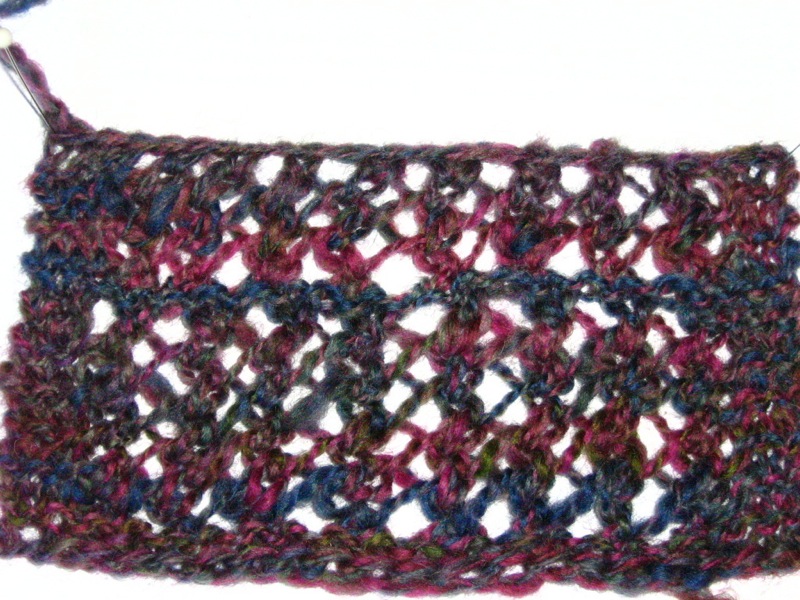
One and a half repeats, half-width swatch of the pattern for my eldest goddaughter’s Yule gift, a convertible wrap/scarf/capelet/hood, knit with the Navajo-plied sample of my own handspun yarn:

Notes for the record (because my journal is mostly for my reference, after all): Swatch measures 6.25 inches wide by 3.75 inches high, pinned out (4 x 6 unpinned). There’s a bit of variation in the thickness of the yarn used, which is understandable; this is the first fibre I’ve spun of this type, and the n-plying was a bit tricky to get used to. But the pattern forgives a lot of the variation. Overall the yarn is pretty even, nice and solid, and knits decently. It’s not as soft as I wanted it to be; I suspect the two-ply will be softer once knit (it’s certainly softer to the touch in the skein), and that may end up being the element that decides two-ply vs. n-ply in the end. I want it to feel soft against her throat. If it’s beautiful but a bit scritchy, she’s not going to want to wear it. As for the pattern, easy-peasy. The hardest thing is going to be remembering which row I’m on of which repeat. I will make a list and check off every row as it’s completed.

(Gentle readers, you’ll have to bear with me as I publicly natter and keep notes about this project for the next two months. I can’t write about the other Yule gifts I’m making since the recipients read the journal. Someday my goddaughter will be old enough to read it, too, and then we won’t be able to squee about the cool stuff we think up for her any more. Speaking of which, I could have sworn we capered about in words and photographs regarding the truly stunning wand HRH made for her this last spring, complete with stunning storage box, but I can’t find it anywhere. Hrm.)

Okay, I have to admit, this particular swatching was a total spinning geek thing. Most knitters hate swatching, especially because swatches aren’t one hundred percent reliable (it also slows you down, because everyone wants to jump right into the Exciting Making Of Things!, and knitting a swatch is the equivalent of checking your materials and measurements sixish times before starting [needle size correct? yarn weight correct? yarn composition correct? affected by washing? stretch? definition?] and of looking both ways fourteen billion times before you cross the street). But swatching a handspun to make sure it behaves the way you need it to (before you spin/ply it all up and discover that it’s useless for the purpose for which it was intended)? Crucial. Because otherwise you not only waste your knitting time, you waste the fibre you’ve spun and the time used to spin it. Also, I’ve never knit with (a) a handspun yarn, let alone (b) a handspun yarn I produced myself. So yes, this was a total spinning geek thing.

I’ve been spinning with the wheel since I got in a third week of September, but the fibre has been for experimental purposes only, or for other people. It wasn’t until I couldn’t find the right yarn with which to knit my goddaughter’s Yule gift and realised that I could spin the yarn I wanted to knit with that I really, truly understood how spinning and knitting were going to work together for me.

I don’t think of myself as a knitter. I’ve finished all of nine things in the past year since I began knitting, mostly hats (two) and scarves (three). Things beyond simple knit stitch scare me. I’ve only just mastered yarn overs and k2tog. I can’t purl to save my life unless I do a bunch of them in a row; alternating purl and knit breaks my brain. Ribbing makes me suicidal or homicidal, depending on the day.

But spinning? Love it. The problem with spinning is you end up with yarn, and you have to figure out some way to use it up. Offloading it to friends once it’s good enough is one way. (Gods bless Ceri, who cheerfully supports this method; so much so that she buys me fluff to spin up so she gets yarn at the end of the process. If anyone else wants in on this, let me know; I am not kidding. Fully serious. You want handspun yarn? Ask; we can work something out where everyone benefits.) The other logical way is to use it up by knitting with it myself.

This was always going to be a problem for me, because as I pointed out above, I don’t think of myself as a knitter. Someone needs a hat or a scarf, so I make one. My office is cold, so I make a lap blanket. I need slippers, so I knit a pair. The boy falls in love with Star Wars, so I knit a lightsabre. (Just work with me on this one, okay?) I don’t stash yarn the way other knitters do; I go out and buy what I need when I need it.

So yes, it took me this long to figure out that I could actually spin a specific yarn for a knitting project I wanted to undertake. Because for me, it’s primarily about the spinning, not the knitting.

(Except in this case, where I decided to make something special for my goddaughter because I remember how I felt when one of my relatives gifted me with something grown-up around this age. I decided to knit a beautiful wrap for her, but I couldn’t find the perfect yarn for the project. Enter spinning as the solution. In this instance, I worked backwards: a knit project needed a handspun yarn, instead of a handspun yarn needing a knit project.)

Anyway, despite my thick skull and amusingly slow connecting of the dots, I here demonstrate my first knitted handspun sample. I’m really extremely proud of it, and I think I have every right to be. Because I not only knitted that swatch, I spun the yarn with which it was knitted. And it acts like real yarn. I can’t get over that bit.

Of course, swatches lie like lying things, so I can’t trust it fully. But I can admire it, even before washing and blocking it. And I invite you to admire it, too, if you like. Really. I’m horrible with compliments, but I’m so thrilled about this particular accomplishment that if you want to compliment it or me, I won’t stop you or duck it, I promise.

Next up: Knitting the same sample with the two-ply made from the same handspun singles I did the n-ply with. Ceri has confirmed that the two-ply is softer to touch and the colours seem brighter, so we’ll see how it behaves when knitted with the same needles in the same pattern. I suspect it will be a bit splittier, but the way it feels may make up for that.

In Which She Is Pleased, Then Despairs, Then Demonstrates Genius

So, this lace scarf I’ve been knitting.

You are not going to believe this.

I get to the end of my scarf, which was essentially defined by how much yarn I had in the skein of Koigu KPPPM. I look at what’s left of the lovely Koigu yarn I’m using. “Oh, I shall do my knit row, and then cast off,” I think. So close! So exciting!

I do my knit row.

I start casting off.

And realise that I’m not going to have enough yarn to do more than a third of my cast off.

I MEAN SERIOUSLY.

I can’t tink or rip back because it’s lace and I don’t have a lifeline. I’m certainly not going to buy another $14 skein of Koigu just to use less than a yard to bind off. So I need to use a length of another yarn to complete the bind off. Do I have anything of the right weight or colour? No!

Hang on. Wait.

Last March I bought a nice fingering weight superwash yarn in an Irish Cream colour with which to knit some fingerless gloves. The ribbing on tiny tiny needles drove me nuts and the project is in hibernation. I never even opened the skein, because I started the cuffs with a brown yarn instead. So I dig the Irish Cream skein out, cut off a yard, and try to dye it a colour at least somewhat similar. I mixe up some kelly green Wilton’s with a touch of brown to tone it down. It works on white paper brilliantly, and the dyeing process works equally brilliantly. It even has a mottled effect, like the original Koigu has! Once it’s dry, I compare it to the Koigu and see that the brown has been unnecessary, because the yarn I used wasn’t pure white: the result is a bit more olivey than the green of the Koigu colourway, and less variegated than the wet strand had suggested. But it’s certainly close enough to use in a pinch. However, I decide to try with another yard, just to see if the green alone matches.

But either way… I just unlocked the Dyeing Yarn achievement. Go me. (Yes, yes, it was pretty much a given once I figured out how to dye fibre, but you never really know till you try.)

ETA: The green alone was too bright, so I overdyed with a touch of brown; the result is toned down and more variegated, which better matches the original yarn. The green bits are very, um, emerald green, though. Still; no one will notice, as it’s just the bind off. (You hear that? NO ONE WILL NOTICE. Or else.)

Come on, yarn. Dry fully already, so I can cast off and be done with the damn scarf.

ETA: And DONE!

And here’s a look at the colour-matching dye trials. The one on the left is the second attempt and the one I used; the one on the right is the first attempt.

Yay!

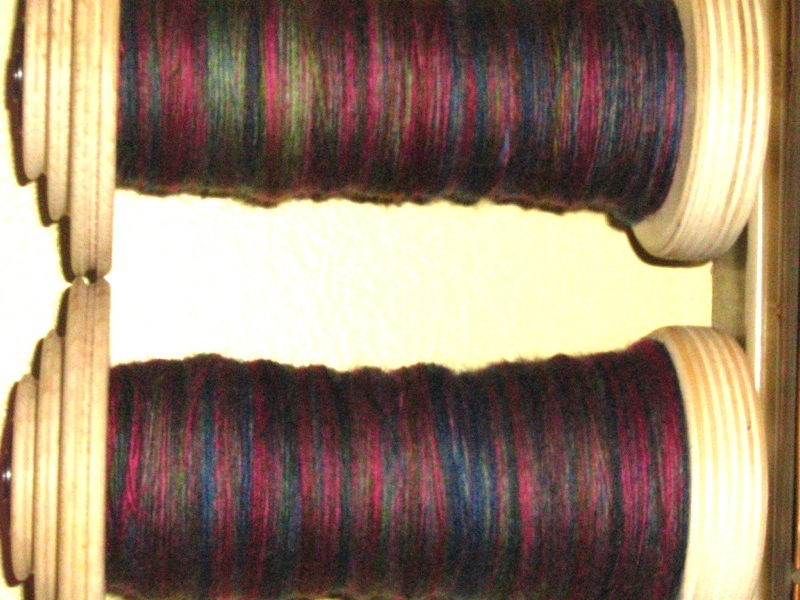
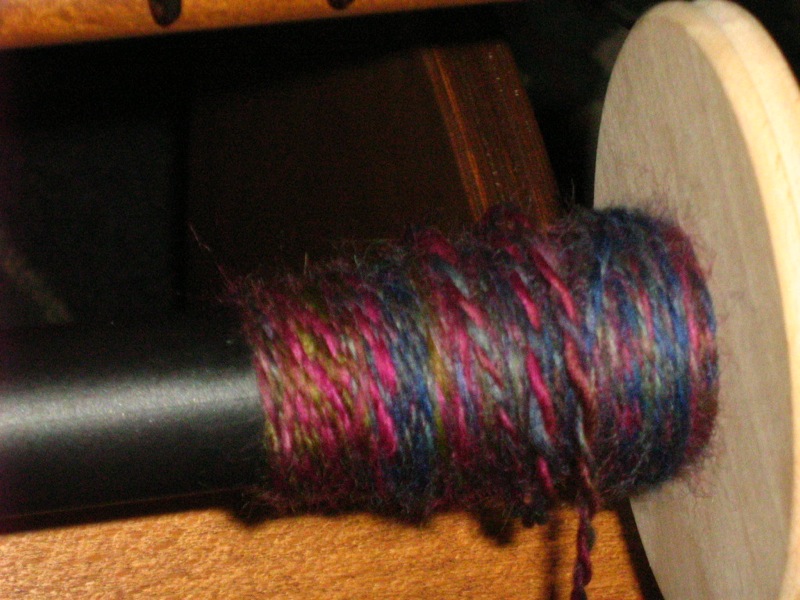
Look what’s all spun up:

Now the burning question: Do I two-ply it, or chain/Navajo-ply it? (The sensible answer is to try both. And because even though I weighed it before spinning it up [I swear, I did] there’s more on the second bobbin than there is on the first, so I can try chain-plying from that one.)

(Hmph. Not sure why the picture isn’t displaying vertically like it’s supposed to. Tilt your head to the left.)

ETA @ 16:50: Oh my gods. Navajo plying with a thread-thin single of my own spinning. I may weep with joy. It’s so smooth.

ETA @ 17:25: Wow. So very different.

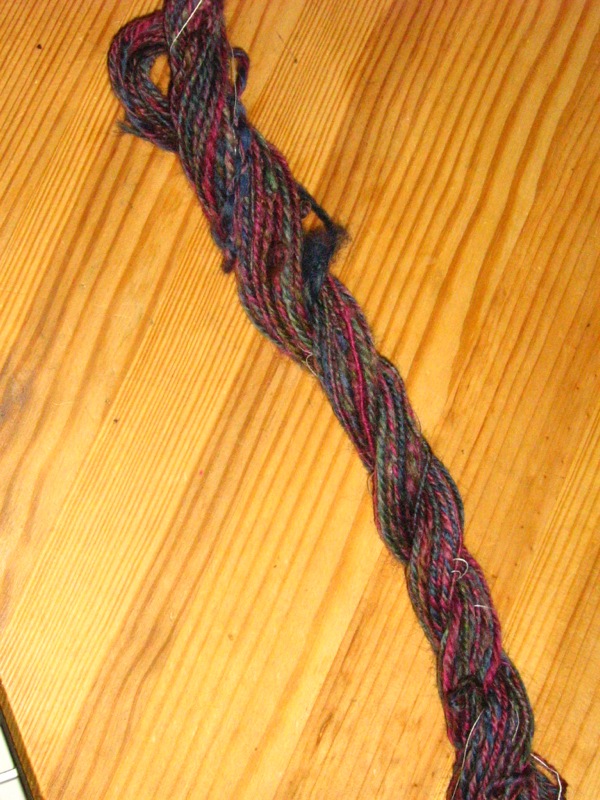
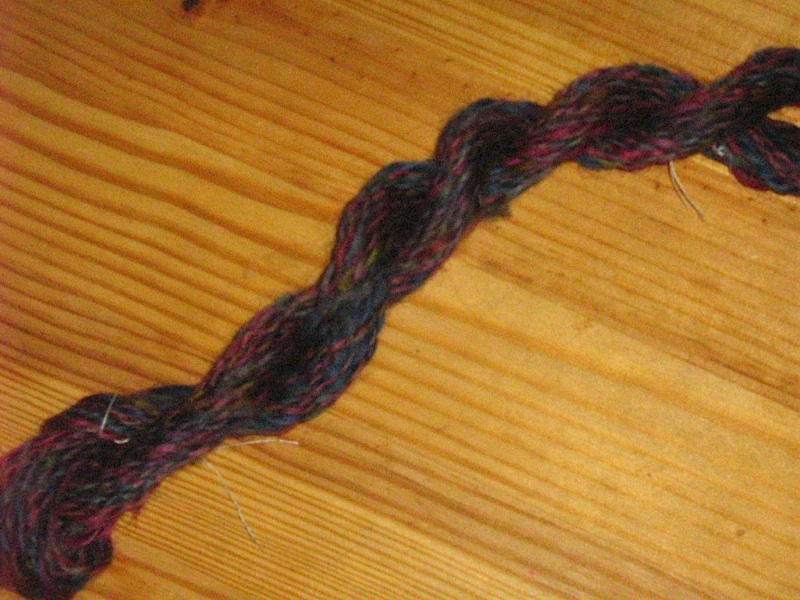
This is the Navajo/cable-plied yarn:

This is the two-ply yarn:

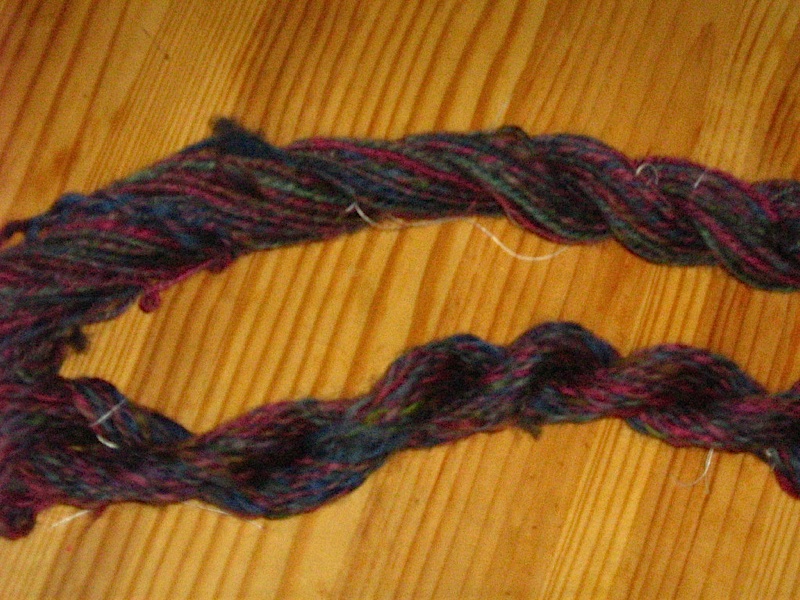
Here they are side by side:

To touch, the cable-plied feels more solid. I want to say harsh, except it’s still soft, just less lofty than the two-ply. Oddly, I think the colours are a bit muddier in the cable-ply than the two-ply. I expected the opposite, since cable-ply is touted as a great way to preserve colour changes. Maybe on a coloured single that changes less frequently than this stuff.

Now I get to wash both, dry them, and knit a sample in the stitch and pattern I’m going to be using it for to see how each sample handles, and how the colours are best shown. I’m kind of excited about swatching with them.

I suspect that I’m going to need Ceri’s in-person input on the samples this Saurday when I swing by her place to pick up my new ball winder and needles.