Monthly Archives: March 2010

In Which She Chronicles The End of the First Weaving Experiment

Wow, I am so very in love with weaving.

It took me about nine hours to weave a test scarf, from setting up the loom up, warping it, and the actual weaving process, to cutting it off and finishing the edges.

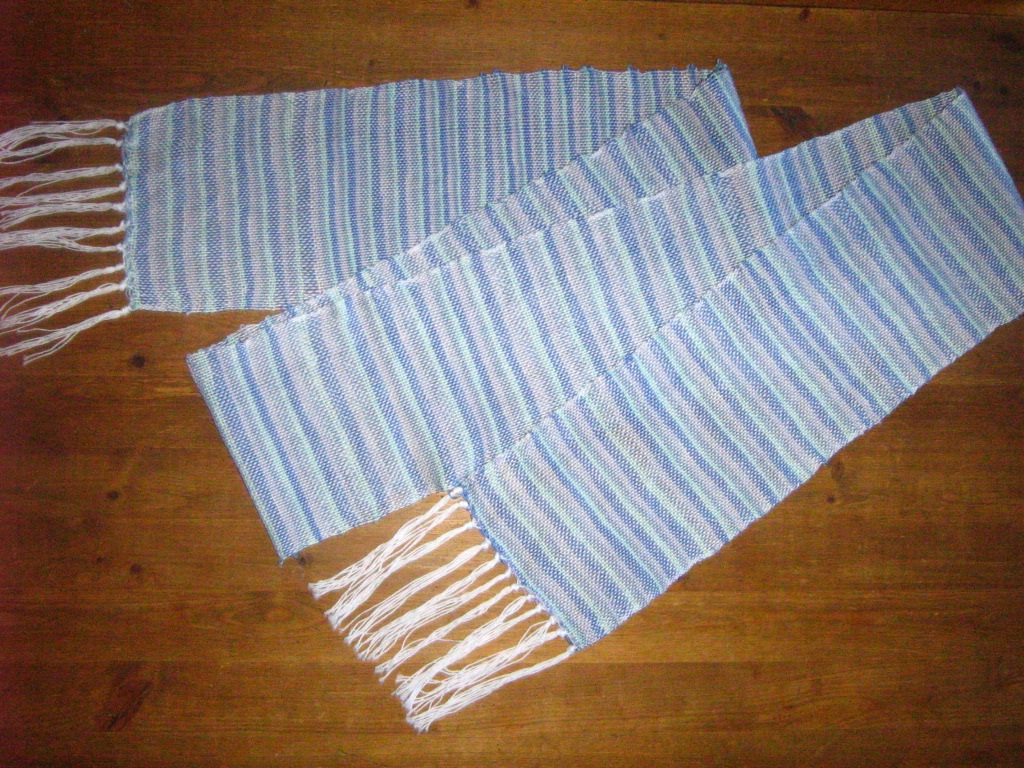
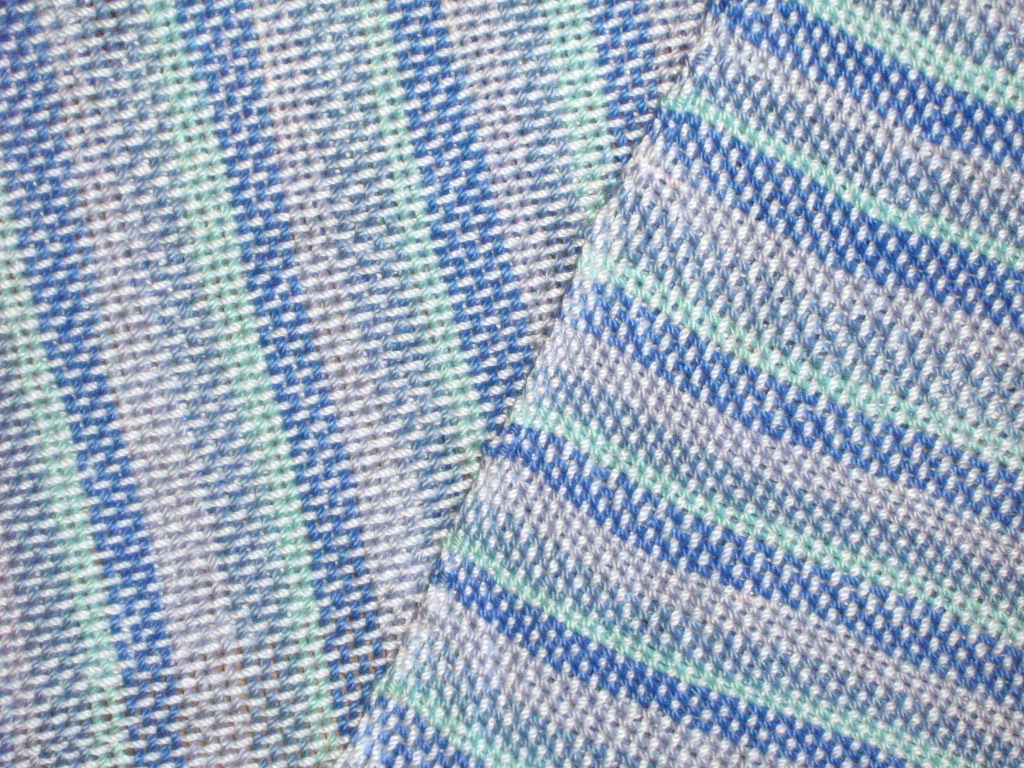
Oh, it is a horrendous scarf. It is too long, and the edges are ragged, and I am not as fond of the colours as I was when I bought the thread (although to cut myself some slack, apart from the white, I got to choose between these blues and a ball of pinks, so I took the lesser of two evils; it’s not like I went looking for this colour) or of how it striped. Laid out to block, it looks like a priest’s stole or something.

But oh, the process. I adore it. It’s quick, and tangible results are there, right there in front of you. And there’s still an element of mystery, because when you take it off the tensioned loom the fabric changes, and some patterns will change, too. And really, you only get to see about six inches of what you’re weaving at one time, so the final reveal is exciting.

I taught myself how to read patterns during a break. And I have chosen a pattern to try, and I will do a real swatch this time, and no, I will not tell you what it is, because Ceri and Scott have formally announced that they are expecting their first baby in September, and so I am going to Make Something.

So! Here’s what things looked like at the end.

Look how even this selvage is! I am very pleased. Of course, that’s about five inches of a six-foot-long scarf. And only one side. Still, I like to think Granddad would have nodded at this bit and deemed it acceptable:

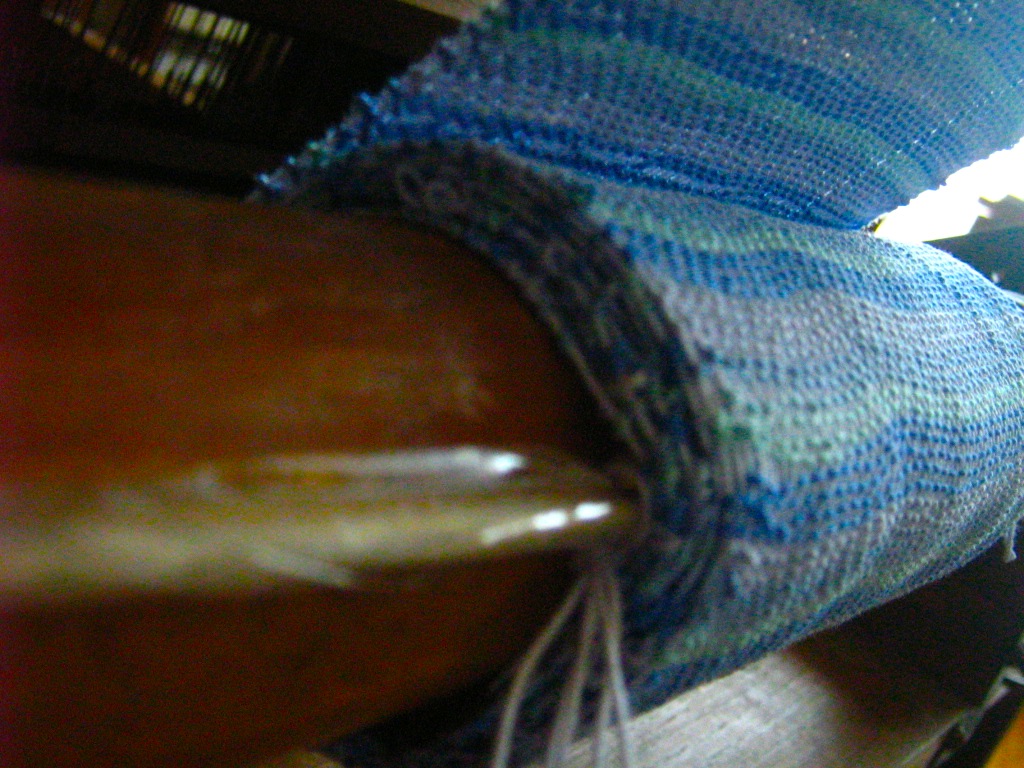
Here’s the woven fabric, all rolled up on the front beam:

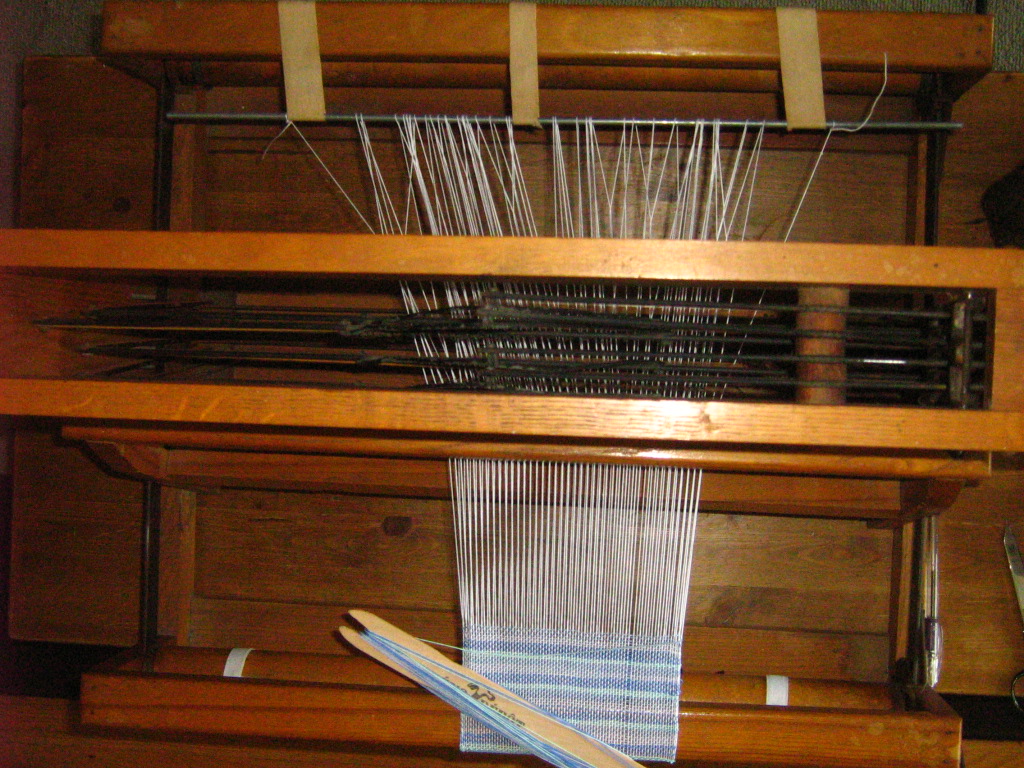
And this is the top view of what it looked like after all the warp had been wound forward as far as it would go and there was only another fourish inches left to weave (you can see that one blank line where I missed a dent in the reed; it makes me wish I’d missed more here and there, so I could have called it a feature instead of a mistake):

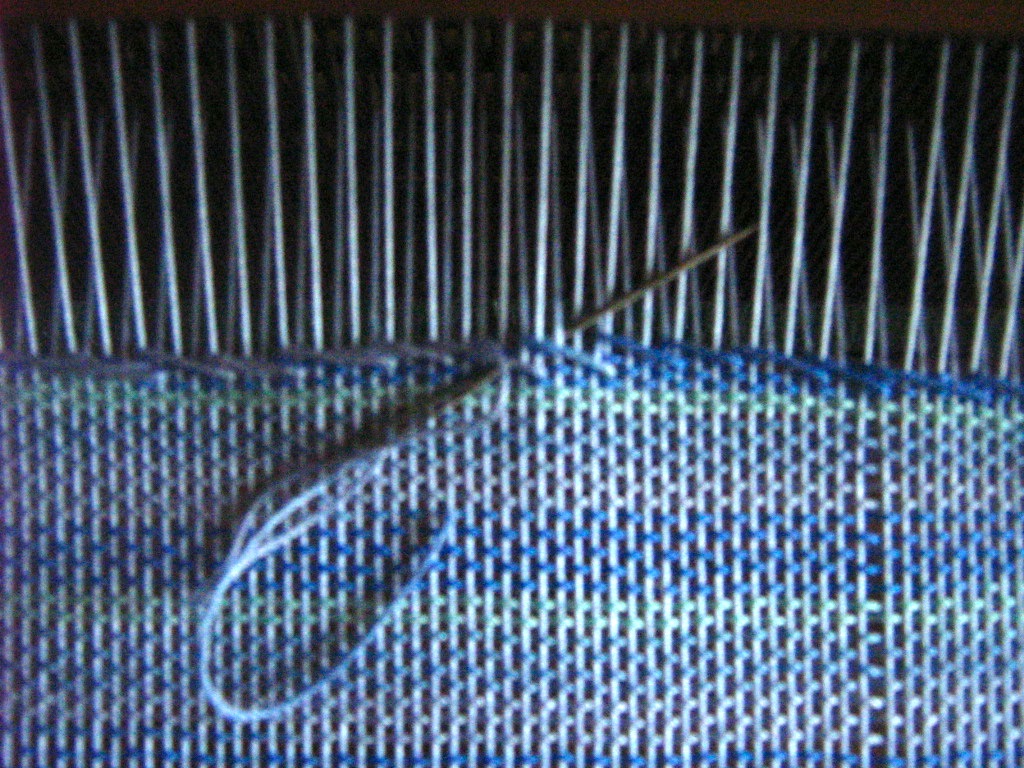
Then I had to hemstitch the ends so they wouldn’t fall apart when I cut the scarf off the loom:

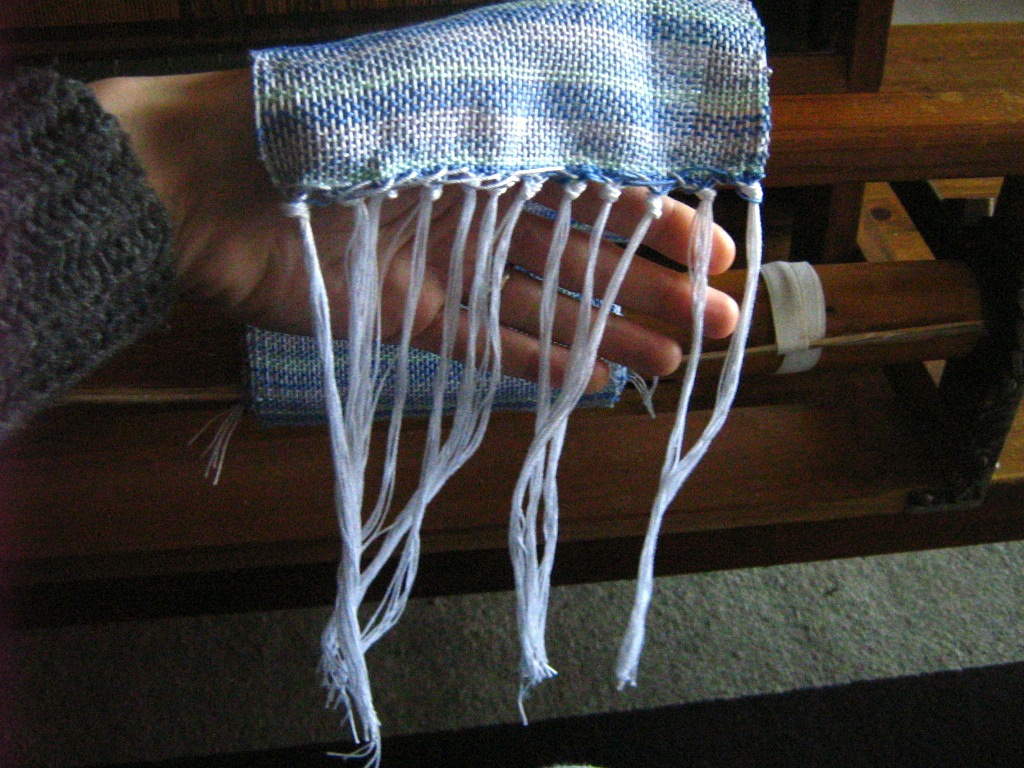
And tie knots in the warp threads to make fringe, which is another way to seal the weave from unravelling. Voila, the end of a scarf! Don’t worry, these fringed warp ends were trimmed to a more sensible length:

The whole thing, taken off the loom, but before washing and blocking:

And now, in all its (questionable) glory, my very first bit of woven anything, AKA the Mile-Long Scarf:

Next? Spinning yarn specifically to be used in a weaving project. I’m thinking browns; I have that woollen-spun chocolate Coopworth around here somewhere…

Stats:

18 epi finished fabric
Five inches wide, one mile six feet long
Approximately 186 yards of warp, 230 yards of weft (I should check this against actual formulas)

In Which She Chronicles Her First Attempt At Weaving

It’s a sunny day; I have no work on my plate. Today, I thought, would be a good day to pull out the antique table loom that’s been sitting in the basement for a year and a half, wipe it down, and give warping it a shot, putting theoretical knowledge I have been collecting for two years into practice. There’s only so much that theoretical knowledge can do for you; someday you have to actually get your hands dirty and figure out what’s what by actually doing it.

So I did. And it was pretty filthy. It’s missing the front apron rod, so I kitbashed one with four bamboo skewers and some packing tape. I needed a stick shuttle, too, so I found a paint stirrer and sawed two notches into it. While cleaning it I looked for any kind of maker’s mark, and apart from the LeClerc name on the reed, the loom looks homemade, possibly from a kit. (This is definitely not a LeClerc loom. The basic design is similar to the current LeClerc Dorothy, but it certainly isn’t one; it looks more like the LeClerc Jano [fifth picture down the page, marked 1936], which is long out of production, but it isn’t precisely that model, either. I suspect someone copied the Jano and used a premade reed in the beater, which is what I was considering doing when I asked HRH if he could build me a rigid heddle loom.)

I’ve been researching rigid heddle looms for a few months, thinking they would be a good gateway drug to the four-harness table loom I’ve got. A couple of weeks ago I realised that the only reason I was looking at rigid heddle looms was because they had only one heddle, which meant that it was the multiple harnesses that were spooking me. And I thought about it, and realised that I don’t have to use all four; I could use one, like the rigid heddle looms. (Experienced weavers will have just spotted an error. Don’t get ahead of my story.) I’d watched enough videos on how to warp rigid heddle looms, and despite the books I have that use different techniques, I reasoned that there wasn’t anything stopping me from warping my table loom like a rigid heddle loom. [ETA: Aha, this is called direct warping, and yes, one can do it on non-rigid heddle looms as well. As I proved today. Good job, me.]

I picked up some crochet cotton last week to practice with, thinking that it would be easier with something light and inexpensive. In some ways, the experience is a positive one; the cotton is very easy to handle and doesn’t fray or pill. On the other hand, it sticks to itself, which makes separating one strand from sixty others not so much fun. It will be interesting to try this with homespun, once I’m finished this test scarf.

And I started warping. I lifted the beater out of the loom, tied one end of the warp thread to the back apron rod, and began measuring it out, using one of the boy’s craft chairs as a warping peg, then looping the warp thread around the back apron rod before bringing it forward again. When I was done, I cut the thread off the ball and tied it off on the back apron rod.

Then I cut the loop made by the chair and tied it in a knot. I wound the warp threads on to the back roller carefully, keeping tension on it, and rolling pieces of paper between the layers of warp so they wouldn’t snarl with one another. (This all took about an hour.)

Then I did just as the rigid heddle videos told me to do: I threaded the dent in every heddle, leaving one thread loose in the slot between each heddle.

I almost tied the front ends of the warp on to the front apron rod before I remembered the beater! Right; I have to sley the reed in the beater. Wow, wouldn’t that have been frustrating if I’d forgotten to put the silly beater in? Chuckle, chuckle.

So I set the beater frame back in the loom, sleyed the reed in it, and tied the front warp to the front apron rod. (Time check: This took about an hour and a half.)

Very proud of myself, I tested the shed: I raised Shaft 1. Yes! A very definite shed!

And then I realised my error. To change the shed on this kind of loom, you need to raise another shaft that has the alternate warp threads threaded through its heddles. On a rigid heddle loom, you lift the heddle off the upper bracket and place it on a lower bracket, kind of dropping the shed below the neutral line of warp.

(Experienced weavers: Here is where the story catches up with you.)

So I untied the front warp ends, pulled them back through the reed, lifted the beater out again, pulled all the warp threads back through the shafts, and started again. This time, I alternated between threading a warp thread through a heddle on Shaft 1, then Shaft 3. And I got halfway across the shafts before realising that I wasn’t going to have enough heddles, since I’d started partway along each shaft. (I have since learned to push ALL the heddles to one side or another and start from the first heddle. You’d think that would be obvious, but I was following some vague sort of ‘balance it all by positioning it in the middle’ sort of thing.)

So I pulled it all back yet again and threaded the heddles for a third time. And this time it worked. It went much faster, too, no doubt thanks to all the practice I’d had. (Time check: This all took an hour and a half.)

And I put the beater back in and sleyed the reed, tied to warp ends to the front apron rod, and balanced the tension. I lifted Shaft 1, and yes, a shed! And when I lifted Shaft 3, a different shed appeared!

Yay, me! (Time check: This took about three quarters of an hour.)

Making my stick shuttle had taken about forty-five minutes before I started the whole project, what with the looking and sawing and sanding. I sat down and wound my weft thread onto it.

I put my waste weft along the bottom to help even out the warp, and then I got to actually weave my first few rows of a scarf. (Time check: This took five minutes.)

Mistakes I will learn from (apart from the ones already outlined above):

* My warp wasn’t centered through the reed, so it’s a bit cockeyed. I’m going to put marks on the frame to help line my warp up as it passes through the various harnesses and the reed.

* My jury-rigged front apron rod is going to have to be a real metal rod, not a bendy bamboo one. Also, the back rod is a bit rough; I may replace it with a smoother metal one.

* I need to get the rust off the harness frames. Perhaps white was not the best colour with which to warp it for the first time.

* Putting the loom on the coffee table was a good idea. Bending over to work on it was not. My back is in serious rebellion. After lunch I dragged the boy’s tiny chair over to the table and worked on warping the loom that way.

* A raddle on the back beam is a good idea to help centre the warp as it passes from the back roller over the beam to the heddles. I can make one and clamp it on.

But you know what? I warped a loom, and wove two inches of scarf. All by myself. It’s sloppy and loopy and crooked and I missed a slot in the reed (a classic rookie mistake, apparently), but I did it. (I keep telling myself that blocking will help a bit.) And I’ve been thinking about my maternal grandfather all day, because he was a weaver, too.

And now, if you don’t mind, I have a scarf to weave.

Dear Winter:

I feel it only fair to warn you that yesterday afternoon on the way home from school, the boy informed his father that he was done with winter. “Because,” he said, “I can’t really make snow angels any more, or play properly, because it’s too wet. So the snow can melt now.”

Winter, you’ve done your best (which, just between you and me, was a slightly below-average turn, but we’ll discuss that on your annual performance review). However, you’ve just been given your walking papers by the kid who plays with weather like it’s a Transformer.

See you next year.

Weekend Roundup: Canada Takes Lots Of Gold Edition

This was a good weekend, despite setbacks.

Saturday morning I had my cello lesson, which was notable for happening half an hour after I woke up. I’d been sleeping badly and HRH decided to let me sleep in, which was lovely, but then he realised at 8:26 that I had a cello lesson at 9:00, and woke me up when I’m usually stepping out the door. I got dressed in record time, he made me tea in my travel mug, and I flew out to the West Island. The lesson was pretty good. It’s nice to be asked, “How long have we been working on this étude?” and to answer, “Well, actually, you assigned it last week and this is the first time I’ve played it for you,” and then hear the teacher say, “Well, you’ve done what you needed to do with that, let’s look at the next one.”

I asked to work on ‘The Entertainer’, which we’re playing in a quartet arrangement for the June recital, and gah. I’m playing Cello 2, and there were some rhythmic things that I just wasn’t getting. My teacher tried all sorts of rearrangements and subdivisions to help me get it, and they just succeeded in confusing me more. I’m a very basic kind of ‘just play the correct rhythm for me and I’ll internalize it’ kind of girl; rhythm tricks just worsen my muddle. I got it in the end, mainly because a few bars later the same rhythm showed up with different notes, only preceded by two eighth notes instead of a quarter note and that seemed to make all the difference. Then we moved to the Boccherini minuet.

Oh, Boccherini. Really.

I have a hate/love relationship with pops and chestnuts. They’re overplayed and so I grit my teeth at them, turn them off when I can, and resist them. If I have to play them, I discover all sorts of lovely things about their internal workings, admit there’s a reason for their popularity, find something to like about them when I hear them, but I still don’t enjoy them. Boccherini’s Minuet is a classic example of an overplayed pop that I hate. And I hate it all the more now that I have to play it, because those opening sixteenth notes are a huge obstacle for me. I can play them in the repeats, but starting from a static bow? Gah. No.

It’s one of those pieces that is all about bow speed and weight and control and I’m sure it’s very character-building, but I’m hating myself because I can’t flipping get that mini-run of sixteenth notes. My teacher pointed out that I can play the piece with my left hand, and that I regularly play much harder pieces in orchestra. (In fact, she expanded that to cover all the Suzuki material I’ve done and will do, which was very gratifying to hear, since sometimes I beat myself up about being on book three after playing for sixteen years.) The point of this is to work the right hand, and my problem does in fact lie entirely with the bow. From a dead stop, I can’t micro-manage the speed to get that lovely sort of swoop and jump for precise phrasing on those two first bars. (There’s an argument in the music world about the validity of the Suzuki method for adults, and what people tend to forget is that review is a huge part of the method. Yes, after sixteen years, you can go back to the earlier books and work on the pieces with all your knowledge and still find technique to polish. The method is a philosophy, not just a set of books.)

We spent the last ten minutes focusing on phrasing those two bars and trying to play them over and over, and I finally said I had to stop because it was getting worse and I was tensing up and losing control of bow and phrasing entirely, and it was doing more harm than good. That’s the kind of thing that stays with me, and despite the lesson overall being great, I had to keep telling myself not to brood about it on the way home.

Saturday afternoon I went out to meet a wonderful couple to discuss performing their handfasting in April. It’s a renewal of vows, seven years to the day they got married, and the handfasting will be followed directly by a Wiccaning for their three and a half month old daughter. I’m very sensitive to working with people I don’t feel comfortable with, but as soon as I walked into their home I felt relaxed, much to my relief. They’re absolutely wonderful women, and I felt so at home with them right off the bat. And their daughter is exquisite.

I got home, watched half of a movie with HRH, then played with the boy till the local grandparents came over for pizza and babysitting. We headed over to Ceri and Scott’s that evening for cake and company, which was very enjoyable, until we got a phone call saying that the boy had been sick. Home we went, and the poor kid was sick a couple more times.

Sunday morning he woke up with a fever, and all he wanted to do was drink water. We’d already cancelled our attendance at his monthly pagan playgroup, so I installed him on the chesterfield with a blanket and some stuffed animals and the Sunday morning cartoons. I cautiously introduced watered juice when he asked for it, then got him to nibble a graham cracker a few hours later. He didn’t want lunch, just juice, but the fever peaked in the early afternoon and had pretty much subsided by the end of the day, at which point he ate half an apple, a bowl of Rice Krispies, and some rice and chicken. Still, apart from his three-hour nap, all he wanted to do was curl up on the chesterfield and watch movies, which was fine until the men’s gold medal hockey game came on and he wanted to watch Star Wars. HRH and I ended up in my office watching the HD stream on my computer. And what a fabulous game! I enjoyed the simultaneous discussion happening on my Twitter list, too. I said last week that Twitter was like having all my friends from all over working together in the same room, popping heads up now and again to chat, and this was similar: it was like we were all watching the game together. When the boy’s movie was over we put the Olympic recap on so we could all watch it together, and even had a picnic in the living room. HRH and I watched the closing ceremonies, too, even though they got progressively weirder and weirder, although I put up with the beavers and moose and voyageurs for the sake of Michael Bublé. The Sochi presentation was incredible.

I am not an Olympic fan. I think there’s an awful lot of controversy about the cost and the impact on the host cities that isn’t considered enough. I’m always irritated by the general emphasis on sport and the lack of equivalent support for arts and culture, and the Olympics just highlight this imbalance for me. And frankly, I’m not a sport fan in general (other than curling, because that’s my game). But being a citizen of the host country for these winter games finally broke down my curmudgeonly resistance and invoked my patriotism. Between the summer and the winter Olympics I will always choose the winter games, and damn, but Canada is good at sports that involve ice and snow. Part of my resistance also comes from the fact that downhill skiing and snowboarding and bobsleighing and such things bore me, and that’s what’s on mainly at the beginning of the winter games. I used to watch figure skating but it doesn’t do it for me any more. However, I happened to watch the women’s freestyle aerial ski jump last Wednesday night for the first time because HRH was watching it when I came home from orchestra, and it was fascinating. We saw the men’s aerial freestyle final too, and the women’s final hockey game, and the women’s final curling game. I’m not much of a hockey fan (my heyday for that was back in late high school), but if pro hockey was played the way the women’s gold medal game was played, I’d watch it regularly. Maybe part of my lack of enthusiasm came from the fact that I’d have needed cable TV to watch the things that actively interested me in the first half of the games.

And I can’t deny the impact my own patriotism had on me. I am a complete and total sucker for our national anthem, especially when sung by enormous stadiums full of people who are crazy proud of our country. The damn ‘let’s make sure they know whose game they’re playing’ Coke commercial that changed to ‘now they know whose game they’re playing’ after Canada won the gold in both women’s and men’s hockey even made me cry. And the whole making history by winning the most gold on a host nation’s home soil? Yeah. I may not be a sport fan, but I am Canadian.

But if I couldn’t have our fabulous national anthem, I’d want Russia’s. I’ve always loved it, and the choral rendition of it at the closing ceremonies was thrilling.

Apart from all that, I tried to spin the overdyed fibre I did last week, and it had felted. I split the roving lengthwise and spun it without drafting, and in the end I have dreadlock-like yarn that I have called ‘Chocolate Cherries for Cthulu’, because it’s dark brown with touches of dark red and green, with green sparkle here and there. It’s awful, although I love the name. No one will ever be able to do anything with it, either. It’s that bad. I’m chalking it up to a learning experience.

Today is March first, and we’re in the home stretch for spring! It was a very spring-like weekend, too.