Category Archives: Photographs

In Which She Chronicles The End of the First Weaving Experiment

Wow, I am so very in love with weaving.

It took me about nine hours to weave a test scarf, from setting up the loom up, warping it, and the actual weaving process, to cutting it off and finishing the edges.

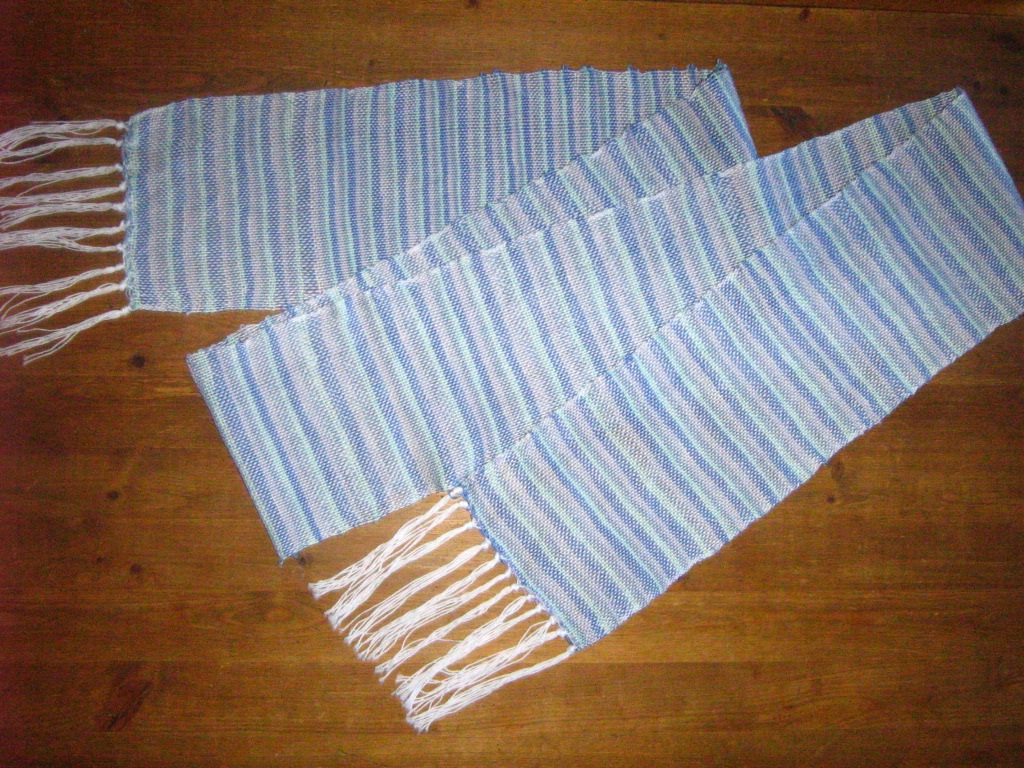
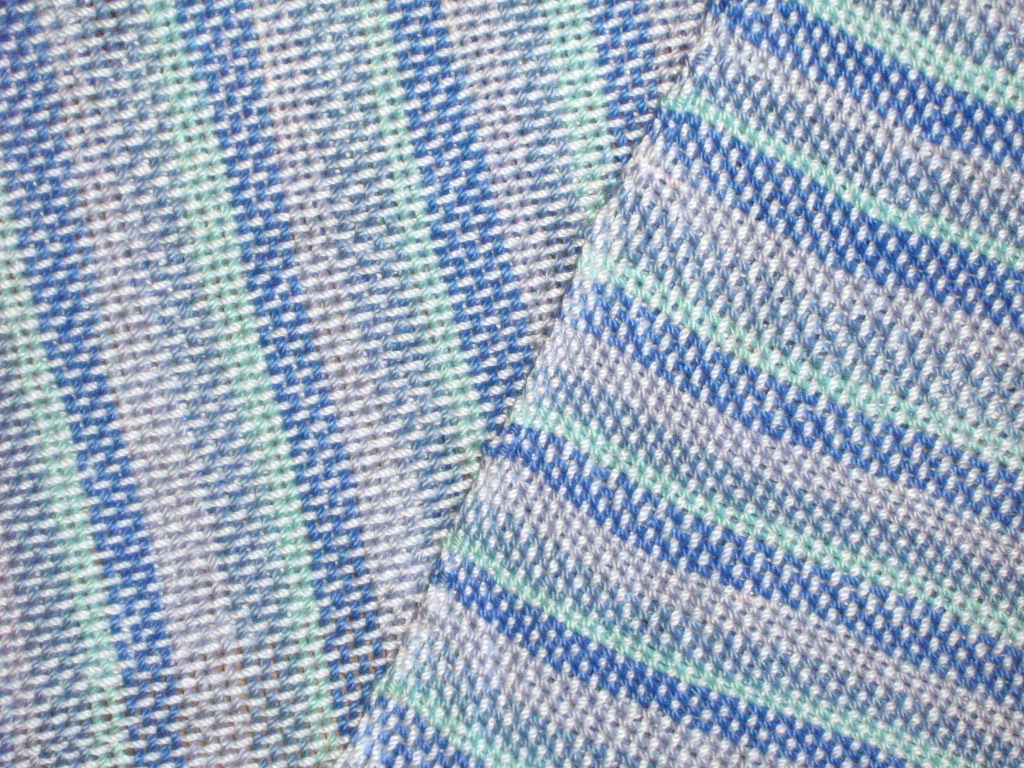
Oh, it is a horrendous scarf. It is too long, and the edges are ragged, and I am not as fond of the colours as I was when I bought the thread (although to cut myself some slack, apart from the white, I got to choose between these blues and a ball of pinks, so I took the lesser of two evils; it’s not like I went looking for this colour) or of how it striped. Laid out to block, it looks like a priest’s stole or something.

But oh, the process. I adore it. It’s quick, and tangible results are there, right there in front of you. And there’s still an element of mystery, because when you take it off the tensioned loom the fabric changes, and some patterns will change, too. And really, you only get to see about six inches of what you’re weaving at one time, so the final reveal is exciting.

I taught myself how to read patterns during a break. And I have chosen a pattern to try, and I will do a real swatch this time, and no, I will not tell you what it is, because Ceri and Scott have formally announced that they are expecting their first baby in September, and so I am going to Make Something.

So! Here’s what things looked like at the end.

Look how even this selvage is! I am very pleased. Of course, that’s about five inches of a six-foot-long scarf. And only one side. Still, I like to think Granddad would have nodded at this bit and deemed it acceptable:

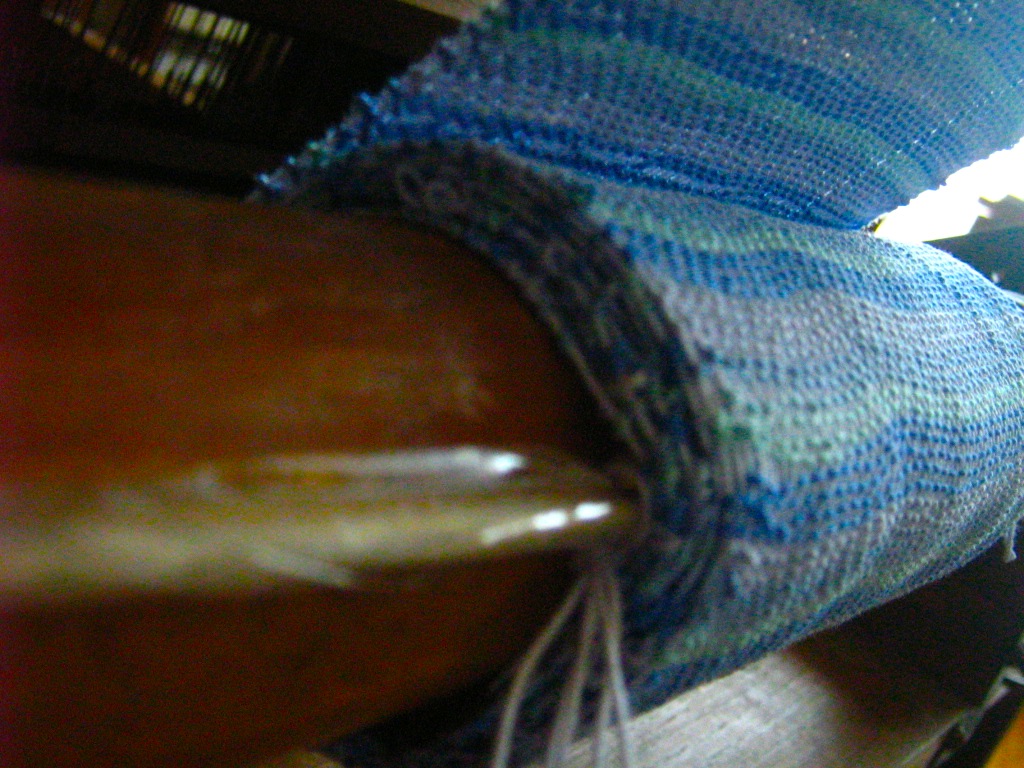
Here’s the woven fabric, all rolled up on the front beam:

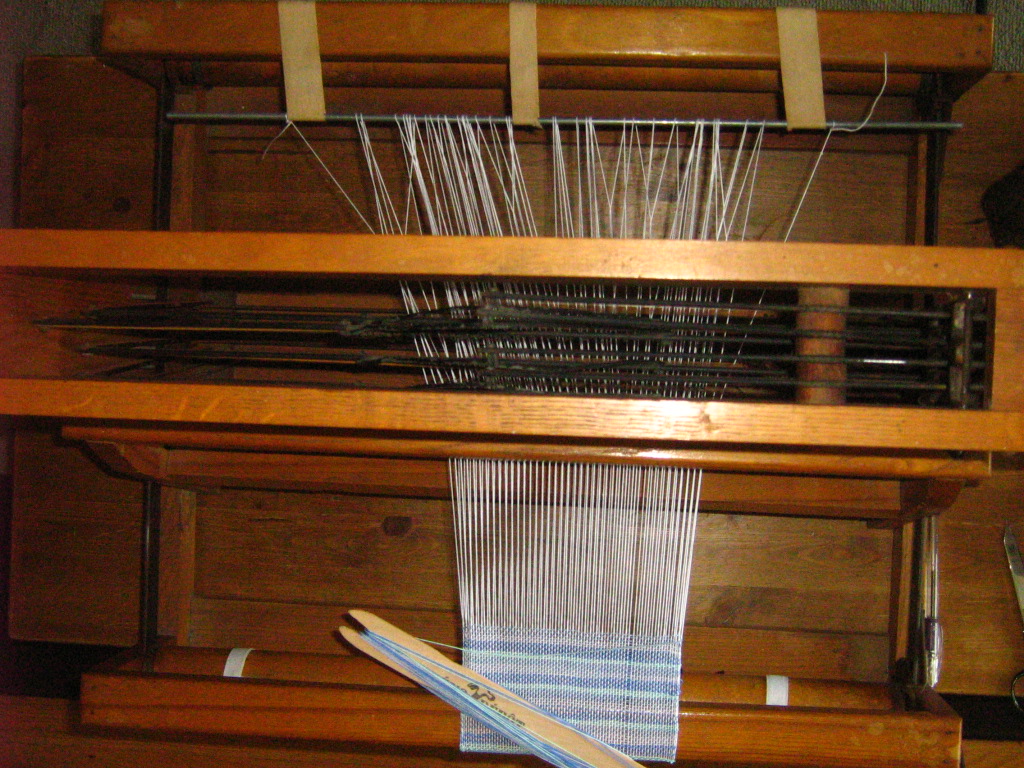
And this is the top view of what it looked like after all the warp had been wound forward as far as it would go and there was only another fourish inches left to weave (you can see that one blank line where I missed a dent in the reed; it makes me wish I’d missed more here and there, so I could have called it a feature instead of a mistake):

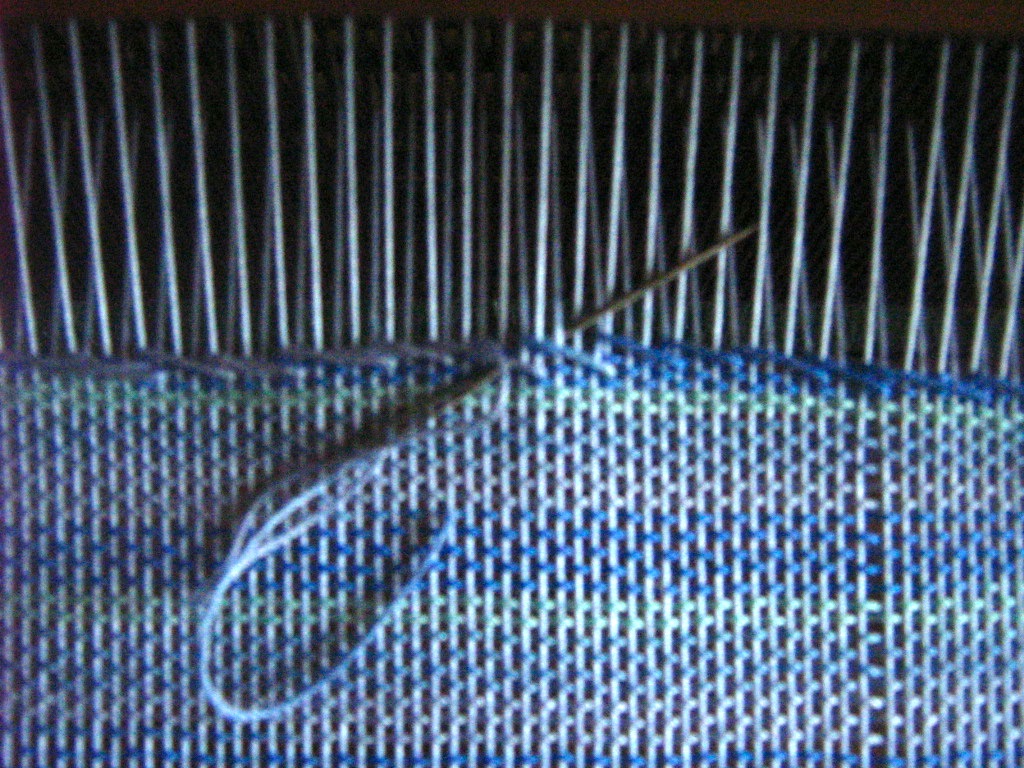
Then I had to hemstitch the ends so they wouldn’t fall apart when I cut the scarf off the loom:

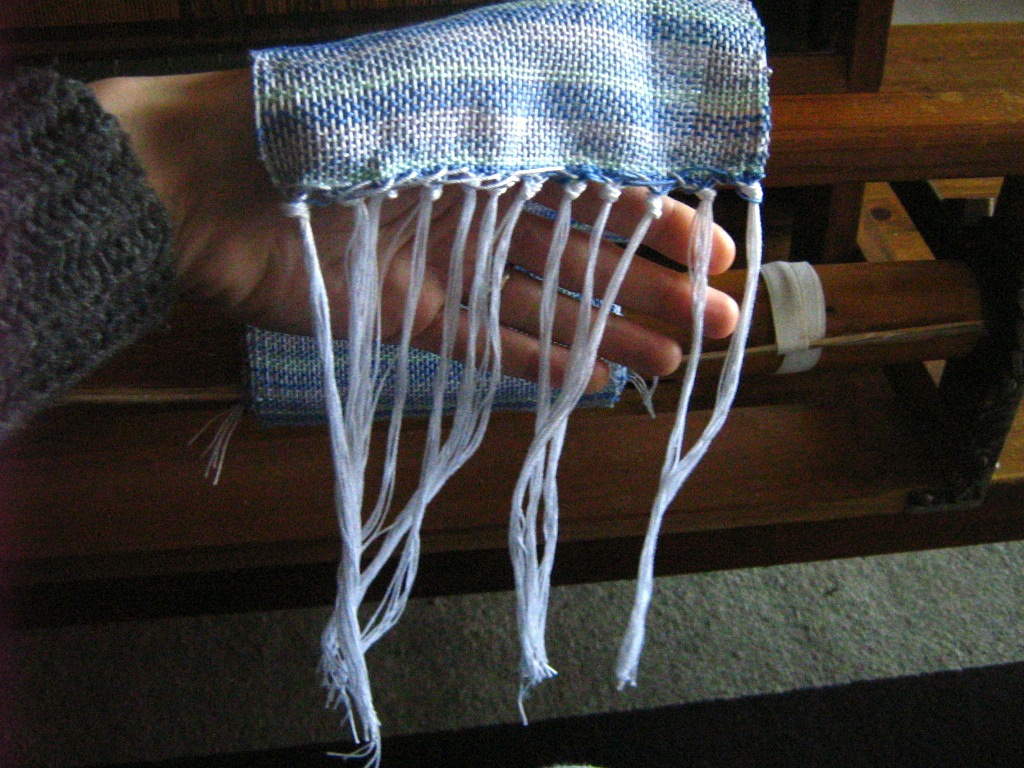
And tie knots in the warp threads to make fringe, which is another way to seal the weave from unravelling. Voila, the end of a scarf! Don’t worry, these fringed warp ends were trimmed to a more sensible length:

The whole thing, taken off the loom, but before washing and blocking:

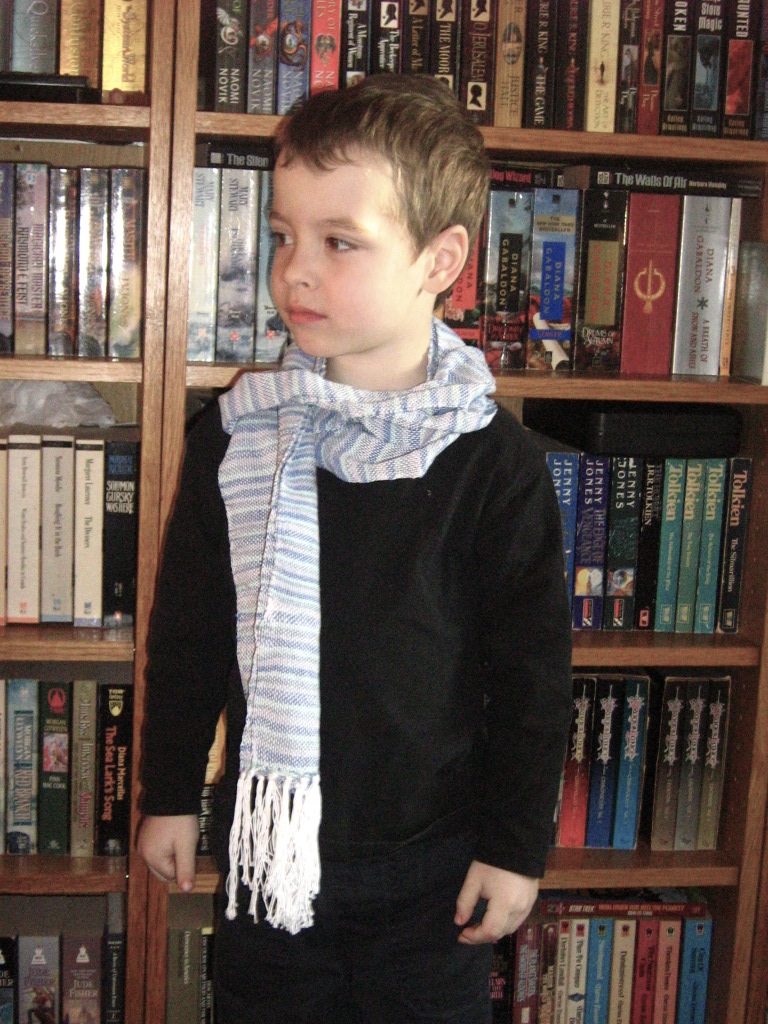
And now, in all its (questionable) glory, my very first bit of woven anything, AKA the Mile-Long Scarf:

Next? Spinning yarn specifically to be used in a weaving project. I’m thinking browns; I have that woollen-spun chocolate Coopworth around here somewhere…

Stats:

18 epi finished fabric
Five inches wide, one mile six feet long
Approximately 186 yards of warp, 230 yards of weft (I should check this against actual formulas)

In Which She Chronicles Her First Attempt At Weaving

It’s a sunny day; I have no work on my plate. Today, I thought, would be a good day to pull out the antique table loom that’s been sitting in the basement for a year and a half, wipe it down, and give warping it a shot, putting theoretical knowledge I have been collecting for two years into practice. There’s only so much that theoretical knowledge can do for you; someday you have to actually get your hands dirty and figure out what’s what by actually doing it.

So I did. And it was pretty filthy. It’s missing the front apron rod, so I kitbashed one with four bamboo skewers and some packing tape. I needed a stick shuttle, too, so I found a paint stirrer and sawed two notches into it. While cleaning it I looked for any kind of maker’s mark, and apart from the LeClerc name on the reed, the loom looks homemade, possibly from a kit. (This is definitely not a LeClerc loom. The basic design is similar to the current LeClerc Dorothy, but it certainly isn’t one; it looks more like the LeClerc Jano [fifth picture down the page, marked 1936], which is long out of production, but it isn’t precisely that model, either. I suspect someone copied the Jano and used a premade reed in the beater, which is what I was considering doing when I asked HRH if he could build me a rigid heddle loom.)

I’ve been researching rigid heddle looms for a few months, thinking they would be a good gateway drug to the four-harness table loom I’ve got. A couple of weeks ago I realised that the only reason I was looking at rigid heddle looms was because they had only one heddle, which meant that it was the multiple harnesses that were spooking me. And I thought about it, and realised that I don’t have to use all four; I could use one, like the rigid heddle looms. (Experienced weavers will have just spotted an error. Don’t get ahead of my story.) I’d watched enough videos on how to warp rigid heddle looms, and despite the books I have that use different techniques, I reasoned that there wasn’t anything stopping me from warping my table loom like a rigid heddle loom. [ETA: Aha, this is called direct warping, and yes, one can do it on non-rigid heddle looms as well. As I proved today. Good job, me.]

I picked up some crochet cotton last week to practice with, thinking that it would be easier with something light and inexpensive. In some ways, the experience is a positive one; the cotton is very easy to handle and doesn’t fray or pill. On the other hand, it sticks to itself, which makes separating one strand from sixty others not so much fun. It will be interesting to try this with homespun, once I’m finished this test scarf.

And I started warping. I lifted the beater out of the loom, tied one end of the warp thread to the back apron rod, and began measuring it out, using one of the boy’s craft chairs as a warping peg, then looping the warp thread around the back apron rod before bringing it forward again. When I was done, I cut the thread off the ball and tied it off on the back apron rod.

Then I cut the loop made by the chair and tied it in a knot. I wound the warp threads on to the back roller carefully, keeping tension on it, and rolling pieces of paper between the layers of warp so they wouldn’t snarl with one another. (This all took about an hour.)

Then I did just as the rigid heddle videos told me to do: I threaded the dent in every heddle, leaving one thread loose in the slot between each heddle.

I almost tied the front ends of the warp on to the front apron rod before I remembered the beater! Right; I have to sley the reed in the beater. Wow, wouldn’t that have been frustrating if I’d forgotten to put the silly beater in? Chuckle, chuckle.

So I set the beater frame back in the loom, sleyed the reed in it, and tied the front warp to the front apron rod. (Time check: This took about an hour and a half.)

Very proud of myself, I tested the shed: I raised Shaft 1. Yes! A very definite shed!

And then I realised my error. To change the shed on this kind of loom, you need to raise another shaft that has the alternate warp threads threaded through its heddles. On a rigid heddle loom, you lift the heddle off the upper bracket and place it on a lower bracket, kind of dropping the shed below the neutral line of warp.

(Experienced weavers: Here is where the story catches up with you.)

So I untied the front warp ends, pulled them back through the reed, lifted the beater out again, pulled all the warp threads back through the shafts, and started again. This time, I alternated between threading a warp thread through a heddle on Shaft 1, then Shaft 3. And I got halfway across the shafts before realising that I wasn’t going to have enough heddles, since I’d started partway along each shaft. (I have since learned to push ALL the heddles to one side or another and start from the first heddle. You’d think that would be obvious, but I was following some vague sort of ‘balance it all by positioning it in the middle’ sort of thing.)

So I pulled it all back yet again and threaded the heddles for a third time. And this time it worked. It went much faster, too, no doubt thanks to all the practice I’d had. (Time check: This all took an hour and a half.)

And I put the beater back in and sleyed the reed, tied to warp ends to the front apron rod, and balanced the tension. I lifted Shaft 1, and yes, a shed! And when I lifted Shaft 3, a different shed appeared!

Yay, me! (Time check: This took about three quarters of an hour.)

Making my stick shuttle had taken about forty-five minutes before I started the whole project, what with the looking and sawing and sanding. I sat down and wound my weft thread onto it.

I put my waste weft along the bottom to help even out the warp, and then I got to actually weave my first few rows of a scarf. (Time check: This took five minutes.)

Mistakes I will learn from (apart from the ones already outlined above):

* My warp wasn’t centered through the reed, so it’s a bit cockeyed. I’m going to put marks on the frame to help line my warp up as it passes through the various harnesses and the reed.

* My jury-rigged front apron rod is going to have to be a real metal rod, not a bendy bamboo one. Also, the back rod is a bit rough; I may replace it with a smoother metal one.

* I need to get the rust off the harness frames. Perhaps white was not the best colour with which to warp it for the first time.

* Putting the loom on the coffee table was a good idea. Bending over to work on it was not. My back is in serious rebellion. After lunch I dragged the boy’s tiny chair over to the table and worked on warping the loom that way.

* A raddle on the back beam is a good idea to help centre the warp as it passes from the back roller over the beam to the heddles. I can make one and clamp it on.

But you know what? I warped a loom, and wove two inches of scarf. All by myself. It’s sloppy and loopy and crooked and I missed a slot in the reed (a classic rookie mistake, apparently), but I did it. (I keep telling myself that blocking will help a bit.) And I’ve been thinking about my maternal grandfather all day, because he was a weaver, too.

And now, if you don’t mind, I have a scarf to weave.

Friday Photos

Somebody won two medals in the preschool Olympics. Plus he was the flagbearer in the closing ceremonies.

The Olympics was very exciting for them. They do this every year, having events like Rolling the Biggest Snowball and Sled-Pulling as well as hockey and such things, but when the Olympics are actually going on at the same time it’s extra-special. They got to watch bits of the real thing at lunchtime, and the boy told us all about building an inukshuk and spray-painting it with food colouring yesterday. I really hope that they took pictures of everything, because I’d love to see it all.

[ETA: I have just been told that the final event was Ice Cream Eating. His win in this event pushed him from the silver to gold medal standing. That’s hilarious.]

And here at home, this is what the bobbins of the singles from the crockpot-dyed fibre looked like:

(Sorry about that third one; I had begun plying them and belatedly realised that I needed a picture, so it isn’t very clear. It’s the only one I took, so it’s all we’ve got.)

And the plied yarn:


[ETA: This is actually a good example of how different yarn looks when different plying techniques are applied to the same singles. In the first photo, standard three-ply yarn is at the top of the photo, and chain-plied yarn at the bottom. The difference is that regular three-ply has three different strands coming from three different bobbins, whereas chain plying uses a single strand pulled through a loop made earlier in the strand. It’s essentially single crochet plus twist. Regular three-ply can look barber pole-y; chain-plied preserves colour change along the strand, so there’s less contrast and a smoother, more subtle shift in colour from one end of the finished plied yarn to the other.]

Fibre Photos

A look at the results of yesterday’s I’m-taking-a-break crockpot dyeing:

This was 2oz of the greyish unknown wool I got in my secondhand lazy kate/bobbin package. There was a touch of angelina or firestar in there, too, which gives it a bit of sparkle. I’d love to say this was a masterfully planned and complicated colourway, but in all honestly it’s just Wilton’s Cornflower Blue, a really strong solution of it, with a natural breaking effect that separated the colour into reds and violets when the acid met the dye solution. I didn’t add vinegar to the dye, just to the water I presoaked the wool with. And even then it wasn’t a lot.

Someday I’ll try the ‘add drops of vinegar one by one at the end of the dyeing process’ thing when I use blue food-grade dyes to preserve the colour, but for now I kind of like the funky effect created by breaking the dye into its colour components with the acid. This will spin up very nicely, I think.

Got the freelance project in yesterday, too. *pats self on the back*

Weekend Roundup

Saturday morning we went out to the la Co-op la Maison Verte store in NDG to pick up gifts for a baby shower. It was snowing, and the boy put on his sunglasses and “snowboarded” down the sidewalks. He looked great, had a tonne of fun, and it really amused me. After lunch the boy and I packed up, picked up a new friend (yay!) and her adorable baby boy, and headed out to the West Island for Miranda’s baby shower. It was terrific to see Debra again (and she hosted a lovely party indeed), and to see Tamu and Phil, neither of whom I had expected to see. (No, I didn’t think about what other guests might logically be there; you may laugh at me.) The boy was very shy and clingy, and spent a lot of time hiding behind me or cuddling me. We gave Tamu a lift back to the metro so she could stay a bit longer, so it was a full car on the way home what with three grown women, a boy, and a six-month-old baby, which was a lot of fun.

Sunday morning I made big pancake breakfast, then realised I didn’t have the energy to go out and do the groceries. So HRH went alone, bless him, and I dozed in a chair while the boy played. When HRH got home I dragged myself to bed and had a two-hour nap.

Once awake again I made lunch, then made peanut butter-chocolate brownies from the Martha Stewart’s Cookies book, and hmm; her recipes are usually great, but this one wasn’t quite right. I substituted cocoa for the chocolate (I usuallly do this, because it’s less expensive) and cut a bit of the sugar comme d’habitude, but next time I’ll use less cocoa, a tad more sugar, and make twice as much peanut butter filling! Then I made hasty chocolate pudding, because I had promised the boy a few days earlier that we’d make pudding for the first time. The boy made it with me, stirring ingredients together and pressing the buttons on the microwave to cook it. (Recipe review: Pretty good for six-minute pudding. I halved the recipe, used brown sugar, added a tablespoonful of butter with the vanilla, and it was great. Next time, I’m cutting a bit of the cocoa, though, and I can’t believe I said that. And it really needs whipped cream to balance the chocolate. Although it occurs to me that a peanut butter swirl through it would be amazing. Hmm.) Then I puttered while the boy napped and HRH briefly went over to his parents’ house.

My monthly group cello lesson later that afternoon was great; we had a new student there, and did some good work on the Corelli. I’m having a stupid time counting, for some reason; I got lost in the middle of everything that I wasn’t playing the first cello line for (I’m fine with first and whatever the bottom line is, but I’m wobbly on the middle voices because I’m not sure how the harmonies are supposed to move or sound like yet). Despite this, our first read-through of Joplin’s “The Entertainer” went pretty well. We sight-read a new piece, “Soldier’s Joy,” that will be paired with “The Ashokan Farewell,” as well as getting the official new music for our quartets and trios. I really enjoy my group lessons, and I wish we could do them more often, although I know they’re a tonne of work for my teacher and the scheduling is enough of a nightmare.

Here’s some pictures of the plied Coopworth I spun up on Friday. The colour on the top photo is more accurate.

That’s 191 yards of nice, springy, lofty, woollen-spun yarn made from 4 oz of chocolate Coopworth roving (real roving, not misnamed combed top), two-ply, 11 wpi.

Fleece Artist Final Skein

My lovely, lovely yarn, let me show you it:

20wpi
128 yards
heavy lace/light fingering weight
chain-plied
Fleece Artist Blue Faced Leicester fibre

(Go on, click View Image to see it in all its lovely, even beauty. And now that it’s all spun and plied, I am fairly certain that it is the Red Fox colourway, which amuses me terribly.)

HRH and I are in love with this colourway. I’m going to keep my eyes open for more, because four ounces doesn’t get you far if you want to actually knit something.