Category Archives: Deep Thoughts

So That’s What I’ve Done With My Life

Found via Muse:

Literacy Test: Highlight in bold those books you’ve read.

(Ed. note: Hunh? Since when has literacy been indicated by the number or calibre of the books you’ve read? Those books might have had an influence on your literacy, but it certainly isn’t directly correlational. Whatever. My comments are scattered throughout in italics.)

Author – Title

— Beowulf
Achebe, Chinua – Things Fall Apart
Agee, James – A Death in the Family
Austen, Jane – Pride and Prejudice and everything else
Baldwin, James – Go Tell It on the Mountain
Beckett, Samuel – Waiting for Godot
Bellow, Saul – The Adventures of Augie March
Bront�, Charlotte – Jane Eyre and everything else
Bront�, Emily – Wuthering Heights
Camus, Albert – The Stranger
Cather, Willa – Death Comes for the Archbishop
Chaucer, Geoffrey – The Canterbury Tales
Chekhov, Anton – The Cherry Orchard
Chopin, Kate – The Awakening
Conrad, Joseph – Heart of Darkness
Cooper, James Fenimore – The Last of the Mohicans
Crane, Stephen – The Red Badge of Courage
Dante – Inferno and the two smash sequels!
de Cervantes, Miguel – Don Quixote
Defoe, Daniel – Robinson Crusoe
Dickens, Charles – A Tale of Two Cities and just about everything else
Dostoyevsky, Fyodor – Crime and Punishment
Douglass, Frederick – Narrative of the Life of Frederick Douglass
Dreiser, Theodore – An American Tragedy
Dumas, Alexandre – The Three Musketeers
Eliot, George – The Mill on the Floss but not Middlemarch? Wha? Who developed this list?
Ellison, Ralph – Invisible Man
Emerson, Ralph Waldo – Selected Essays
Faulkner, William – As I Lay Dying
Faulkner, William – The Sound and the Fury
Fielding, Henry – Tom Jones
Fitzgerald, F. Scott – The Great Gatsby
Flaubert, Gustave – Madame Bovary
Ford, Ford Madox – The Good Soldier
Goethe, Johann Wolfgang von – Faust in two languages!
Golding, William – Lord of the Flies
Hardy, Thomas – Tess of the d’Urbervilles
Hawthorne, Nathaniel – The Scarlet Letter
Heller, Joseph – Catch 22
Hemingway, Ernest – A Farewell to Arms
Homer – The Iliad
Homer – The Odyssey
Hugo, Victor – The Hunchback of Notre Dame but not Les Miserables?
Hurston, Zora Neale – Their Eyes Were Watching God
Huxley, Aldous – Brave New World
Ibsen, Henrik – A Doll’s House
James, Henry – The Portrait of a Lady
James, Henry – The Turn of the Screw
Joyce, James – A Portrait of the Artist as a Young Man thank you for not listing Ulysses
Kafka, Franz – The Metamorphosis
Kingston, Maxine Hong – The Woman Warrior
Lee, Harper – To Kill a Mockingbird
Lewis, Sinclair – Babbitt
London, Jack – The Call of the Wild
Mann, Thomas – The Magic Mountain
Marquez, Gabriel Garc�a – One Hundred Years of Solitude
Herman – Bartleby the Scrivener
Melville, Herman – Moby Dick
Miller, Arthur – The Crucible
Morrison, Toni – Beloved
O’Connor, Flannery – A Good Man is Hard to Find
O’Neill, Eugene – Long Day’s Journey into Night
Orwell, George – Animal Farm
Pasternak, Boris – Doctor Zhivago
Plath, Sylvia – The Bell Jar
Poe, Edgar Allan – Selected Tales
Proust, Marcel – Swann’s Way
Pynchon, Thomas – The Crying of Lot 49
Remarque, Erich Maria – All Quiet on the Western Front
Rostand, Edmond – Cyrano de Bergerac
Roth, Henry – Call It Sleep
Salinger, J.D. – The Catcher in the Rye
Shakespeare, William – Hamlet
Shakespeare, William – Macbeth
Shakespeare, William – A Midsummer Night’s Dream
Shakespeare, William – Romeo and Juliet and just about everything else
Shaw, George Bernard – Pygmalion
Shelley, Mary – Frankenstein
Silko, Leslie Marmon – Ceremony
Solzhenitsyn, Alexander – One Day in the Life of Ivan Denisovich
Sophocles – Antigone in two languages!
Sophocles – Oedipus Rex
Steinbeck, John – The Grapes of Wrath
Stevenson, Robert Louis – Treasure Island
Stowe, Harriet Beecher – Uncle Tom’s Cabin
Swift, Jonathan – Gulliver’s Travels
Thackeray, William – Vanity Fair
Thoreau, Henry David – Walden
Tolstoy, Leo – War and Peace
Turgenev, Ivan – Fathers and Sons
Twain, Mark – The Adventures of Huckleberry Finn
Voltaire – Candide
Vonnegut, Kurt Jr. – Slaughterhouse-Five
Walker, Alice – The Color Purple
Wharton, Edith – The House of Mirth
Welty, Eudora – Collected Stories
Whitman, Walt – Leaves of Grass
Wilde, Oscar – The Picture of Dorian Gray
Williams, Tennessee – The Glass Menagerie
Woolf, Virginia – To the Lighthouse and plusieres autres titres
Wright, Richard – Native Son you know, I honestly can’t remember

This list is obviously American, because it doesn’t ask if you’ve read Two Solitudes or Kamouraska. And where’s Fahrenheit 451? I find it interesting that the list is fiction and poetry, with Emerson and Thoreau thrown in, but doesn’t include important philosophical works. Apparently philosophy (Aristotle, Hegel, Kant, whoever) improves the mind but not the literacy rate. I think literacy evaluators ought to sit down with Kant and try to follow the a priori theory. They’d understand just how much philosophy rests on the ability to read and comprehend.

I took a couple of American Literature courses at university, which is how I came to read things like Theodore Dreiser and Henry James. Most of the rest of my score here is attributed to the double BA in Liberal Arts and English Lit. (That and a decidedly anti-social streak.) And yet I’ve managed to reach the age I am without reading the high school classics Catch-22 and Catcher in the Rye. Go figure.

Have fun.
Things I Didn’t Know I Knew

I chose today as the inaugural day to begin typing the spellcrafting book, it being International Creativity Day and all. I had a few point-form notes that I’d written down in a notebook on Monday, and as I typed them out I expanded upon them, just as I’d planned. And then, out of nowhere, I was writing pages about Maslow’s Hierarchy of Needs and why so many spellbooks concentrate on basic needs like prosperity and love.

*blink* *blink*

No, I’m not sure where it came from either. It never occurred to me before, although it certainly makes a lot of sense.

God As A Fellow Artist

Surrealmuse takes a look at art in several different ways. Her subtitle was what really caught my attention: When the muse is alive in anyone, they become an inventive, searching, self-expressing creature.

I found this paragraph in Art & Spirituality:

I envision God as another fellow artist, the master artist with a touch of scientific knowledge, but an artist all the same. Who else but an artist would create such beautiful scenic beaches and mountains? With the same token, the dark side of God’s artistic vision is illustrated in the creation of angry, fiery volcanoes. But God also has a sense of humor, who else could create a platypus?

I thought that might get your attention. Enjoy the site, and think about how your own creativity conveys your spirituality.

Synchronicity Strikes

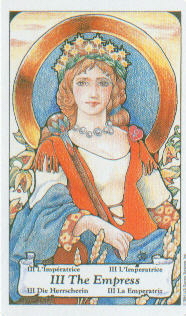
I keep a Hanson-Roberts tarot deck on my desk to play with when I get stuck on something. A couple of days ago I shuffled and drew three cards: Justice, the Empress, and the Star.

They’re still on my desk, because something’s been niggling at me. Namely, the fact that as soon as I saw the Empress, I said, “Ooh, Brid!”

Now, Brid is usually seen as a Maiden figure. (Paradoxical association has Saint Brigit being a matron of pregnant women. Go figure.) She is associated with the first stirrings of spring, creativity, healing, and crafts, among other things. The Hanson-Roberts deck (which isn’t my favourite by a long shot; it’s just slightly smaller than the average tarot deck and fits my hands comfortably) portrays the Empress as a golden brown-haired woman crowned with twelve tiny flames, gowned in a dress of brown-red, white, and soft blue, sitting in a chair that has a back with a large round headrest. The blue headrest is outlined in gold, and provides a frame for her face. Traditionally the Empress indicates a woman of mid-age, and is associated with fruitfulness, family, motherhood, abundance, progress and such things.

So my immediate recognition of the Empress card as Brid stumped me for a moment. Then I looked at the card again, thought about my research, and began to understand why.

I’ve been doing some key research on the concept of Brid as figure of Sovereignity, a representative of the energy of the land itself. In that respect, the figure of the Empress and her associations of fertility and abundance work quite well. The tiny flames crowning her head are of course associated with Brid’s fire aspect. The blues of the card call to mind Brid’s water affiliation through her healing aspect. The grain growing around the Empress is not only used to feed the people of the land, but the cattle and other domestic herds who are under Brid’s protection also. The round disk of the chair back brings to mind the possible solar connection Brid has, as well.

If someone had asked me to choose a Major Arcana card to represent Brid before this happened, I’d likely have chosen only the Star. I’m a writer; I tend to relate to Brid in her creative aspect first and foremost. These three cards together, though, seem to show me the three sides of Brid: the brightness of inspiration in the Star, the fertile Sovereignity aspect of the Empress, and the rulership/warrior aspect of Justice.

A good writer and researcher keeps her mind open to possibilities. And since in my world I choose to believe that there is no such thing as coincidence, and since it was the Empress card that really jumped out at me, I think I’ll be following this line of Sovereignity research for a while.

The Other Side of the Fence

Isn’t it ironic how when we begin a cold, on our way down we hit a certain stage of illness where we operate at 80% efficiency and we moan about how I feel just awful, awful. Then when we hit the same efficiency level on the way to getting well again, we rejoice and say, Isn’t it wonderful! I feel so good!

It’s all relative.

Defeated

Beethoven won.

The Ninth is going to sound fantastic. I don’t think I’m going back for the Bruckner Mass in F minor in May, though. I just can’t keep up; I’m not good enough. It’s been a terrific challenge, but I don’t have the time to devote to Cantabile as well as chamber orchestra. Besides, they’ve scheduled the four Bruckner rehearsals on Sunday afternoons yet again, and I’m tired of having to miss or skip out halfway through classes I’m supposed to be teaching.

I know I have a bad habit of underestimating my talents and skills, but last night’s rehearsal was embarrassing and depressing. The technical expertise required in the fourth and first movements are just beyond my current abilities. The entire section agrees that the technical challenge is above what they’re usually called on to do (and I can just imagine what Beethoven’s musicians must have said to him), but they still manage to pull off a significant percentage of the required work. I feel clumsy and klutzy, and I wonder what I’m actually contributing to the orchestra. Too often I lose my hold on what I’m doing and end up sitting there helplessly, trying to figure out where the heck we are, and where I can next come in with some sort of confidence.

There’s a difference between undervaluing yourself, and knowing that you’re just not quite good enough. If I had the luxury of time to really focus on working the music, I might stay on. With my schedule the way it is, however, I think it’s better all around if I focus my energies on chamber orchestra, teaching, and the slew of editing work.

I gave this a really good shot, and I’m proud of the fact that I did it. I adored the Puccini, and the Elgar was a bear but I mostly pulled that off too. I think back to how I felt when I joined chamber orchestra, and I stuck through that because my awkward playing was due to nerves and being tremendously shy. The technical challenges are different there (chamber vs symphonic!), and I do really well. I passed the nerves and new-girl shyness quite a while ago in Cantabile. I know I’m not where I ought to be in order to perform adequately.

It’s been fun, though. And the actual performance of the Ninth will be phenomenal, despite my fumblings.

Birds on the Brain

While we were waiting for my glasses to be ready, we popped into the pet store and as usual I spent too much time with the birds.

I love birds of all forms, but intelligent bids really fascinate me. They tend to like me, too, trying to catch my attention in any way they possibly can. On a slow afternoon a few years ago, a bird handler invited me into the restricted area, and a young soft buttercream cockatiel fell in love with me, sidling out of her cage and up my arm to lean her head against my cheek, murmuring softly to me, and stretching a wing out every once in a while. She loved my hair, and was very sorry to see me go when I finally had to leave, half an hour later. My own heart almost broke. I didn’t have the two thousand dollars to leave behind in her place, however, and so we were parted forever.

There’s something wonderful about the bright eyes of birds, and how they act when different people are around. When I walk into a bird area, they usually cluster at the fronts of the cages and either screech so I turn to look at them, or flap their wings a lot. They flirt incessantly too. The first time HRH saw it happen and watched incredulously as I had conversations with them, he called me Polgara (and if you read David Eddings, you know why).

Roo has told me stories of her lovebird, and I had lovebirds hopping up and down at me today as well, saying, “Look at me, look at me!” I love talking to her canary when I’m over at her place, but as beautiful as he is, I don’t think a canary is for me. I’ve had finches and a dove, but finches are too small to really interact with, and the dove, well, wasn’t so bright. We have cats, sure, but as the bird handler told us today, she has cats and two cockatiels that walk around freely; the cats know not to bother them. (One wonders what kind of scars the felines display as proof of their acquisition of bird ettiquette.)

So when we have a larger home, and I have a room of my own, there is a bird in my future. Perhaps a conure; perhaps a lovebird. Who knows?