 Last night was my first post-FMS diagnosis orchestra rehearsal, and I was observing my energy levels and physical activity and things like that in a completely different way, instead of just being tired and depressed about my inability to pull it together and play properly. The concentration problems that have slowly crept into my orchestra experience — focusing on the score on the stand, staying in the rhythm, predicting the next bars of music rhythm- or note-wise– may very well be connected to FMS. I used to be able to know what came next without being there yet, when listening to or playing a piece of music. I used to be able to do this with a piece of music I’d never heard or played before: I could predict it, and if it wasn’t dead on then it worked musically with/against what actually did come next. I’ve slowly lost that ability over the past year. I’ve been having problems feeling the music, getting inside it in order to feel what comes next so that what I’m playing now flows into it the right way. It’s not related to how many times I listen to a recording to be familiar with the way the music goes, or how often I practice it, either. It’s a disconnect that happens somewhere in my mind as I’m playing. (Thanks so much, cognitive dysfunction.)
My fine motor control has grown a bit clumsier, too. I can’t do finicky things like trills or mordents like I used to, or throw out thirty-second notes in rapid scale-like patterns without lots of practice at slow speeds. I was putting all this down to not enough practice and the natural ageing process, but looking back I can admit that these sort of things don’t hit to this extent within the space of seven months. My hands and fingers are clumsier, which makes sense from a medical viewpoint now I know that FMS affects the musculoskeletal-CNS dynamic and creates a weakness in the limbs (and by extension, the limb extensions, hello clumsy fingers!).
The drive home had me thinking about the commitment to orchestra. At its most basic, it’s a way to make sure I play at least once a week. Now I need to look at it as a way to work on my hand and finger fine motor control, my focus and concentration, and the process of wrapping my mind around the image of the music as a whole to help me get from point A to point B. I have to cut myself some slack about my level of performance, which has, I admit, decreased: I can’t handle quick complicated passages like I used to, or be as accurate rhythm- and phrase-wise all the time. And yet at the same time, my position work has improved even more over the past six or seven months, which confuses me. Evidently shifts don’t require the same kind of fine motor control that quick fingering does, although it asks for fast precise movements in a different way. Somehow my understanding of how notes relate to one another in high positions and how my fingers have to move to play them has developed without conscious work on my part. It’s good to know that positive things are still happening in my brain beyond the fibro-fog while other musculoskeletal-related things are experiencing technical difficulty.
Last night I didn’t hurt as much as I used to after or during the rehearsal, either. Hurrah for medication.
I have to allow myself to accept that it’s not all my fault. I’m not playing less well because I’m not practising; I am not failing to be as good as I was because of lack of application, but because my mind and body aren’t co-operating. Practice would help, of course, because as I keep hammering into my skull (with limited success, evidently) if I’m this good without regular or structured practice, just think how good I could be if I did practice more often, and properly. But with the challenges and limits the FMS is trying to set on me, practice could be a very good exercise in pushing back the cognitive fog and keeping hands and arms limber, with the bonus of, you know, helping me play better.
I need to carve out a routine where I play at home more. Fifteen minutes in the morning before the computer gets turned on on work days, at the very least, would be better than nothing. I think repetitive work on the places where I fall apart at orchestra is a good place to start. (Gounod second movement of symphony numero uno, I’m looking at you, you example of rhythm going somewhere other than my brain expects it to go every single time, you. Behave.)
 Liam’s handle on language has taken yet another leap. I was sitting next to the boy while we watched a DVD the other week and realized that I was having a full-blown conversation with my son about the Muppets, complete with analysis of humour and use of similes, and we were both taking it for granted. I am just blown away by how communication evolves over the first three years.
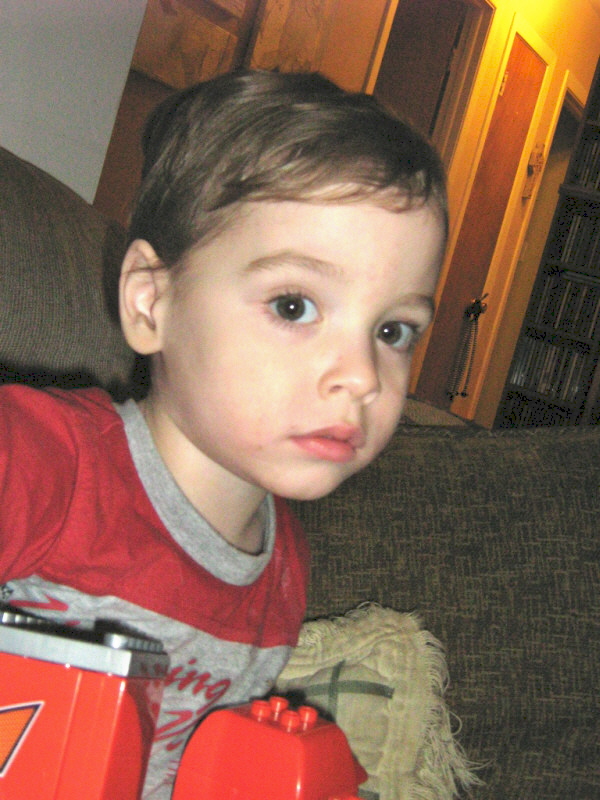 The Muppets are very big in our house these days. He loves the opening sequence, dancing and singing along here and there, always joining in for the final line, raising his hands up in the air and saying “SHOOOOOW!” with all the Muppets on-screen. His favourite skit is Pigs In Space, which he calls “Piggies in the Spaceship”. He loves Robin and Miss Piggy, and is quite fond of Kermit. He impressed me the other night when the news anchor Muppet came on and started talking. Liam narrowed his eyes at the screen and said, “That Kermit.” I tried to explain that the person providing the newscaster’s voice was the same person who did Kermit’s voice, but it went right over his head or out into left field or something, and understandably so: Muppets are Muppets. When kids talk to them in person, they talk to the Muppet, not the person standing there holding it. Of course the puppets talk on their own; a Muppeteer is an alien concept. So I rationalized it by saying that the news anchor was Kermit in disguise. Liam looked at me, opened his mouth in a silent “Ah!” as if he had been initiated into a deep adult secret, and was satisfied.
 Lately he has really gotten into playing Hide and Seek. The only problem is that he gets so excited when he hides that when whoever is seeking him narrates their search, he responds to it. “Are you in the… bedroom?” I will say, and “Noooo!” he will exclaim from the bathroom. HRH was trying to straighten out the problem the other night and had a great time chuckling at the boy when they hid in the bathroom together, Liam bouncing up and down, hands over his mouth to keep himself quiet, and eyes wide, nearly bursting with excitement as I searched. His play has developed into a fascinating display of imagination and storytelling. Trains meet and converse and part, cars encounter difficulties and challenges and work through them. Sometimes he provides all the voices, and other times he narrates what is happening to himself or to other toys. And he’s engaging in very obvious pretending now. “Maggie is the white Totoro!” he will say. “Let’s follow her! Oh no, we can’t see her! Now she under the house!” (Poor Maggie gets cast as a wide variety of things, some of them inanimate, and is really doing a heroic job of keeping up with the exuberance of a two and a half year old who is now coordinated enough to pick her up and lug her around.) One of his current special possessions is a blue velveteen ring box that I found while clearing out a closet. “I can have this?” he said. Later I found it under the chesterfield and was going to throw it out when he grabbed it from me and said, “No, you can’t! That my game!” The implication was clear: If you won’t let me play with your Nintendo DS, I’ll make my own game, thank you very much. So we coloured dots with markers inside for buttons, and he sits on the sofa and presses them, looking at the upper ‘screen’. Over the past month it has also evolved to be his ‘computer’. It sits on his chest of drawers.
 His current favourite books are the
 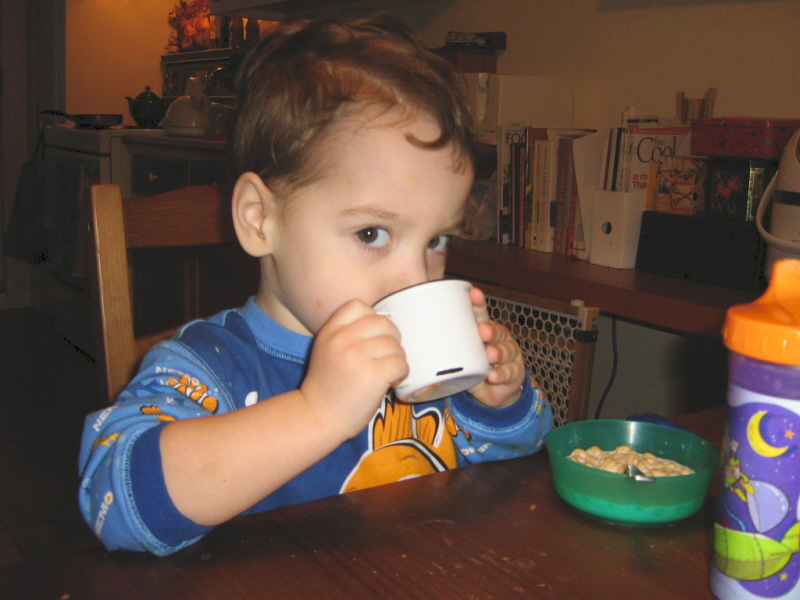 Liam can be such a funny little thing. When HRH wore an old paint-spotted shirt last weekend he got very upset: “Dada, it dirty. We clean it? We clean it for you?” With all the winter storms we’ve been having there has been major snow removal going on (although not anywhere near the frequency at which it ought to be happening), and he’s glued to the front window when the giant snowblowers and dump trucks inch down the street. He renamed his toy excavator ‘the snowblower’ and pushes it around the floor behind the matching dump truck, the scoop angled up over the dump truck like the snowblower does. He watched our next-door neighbour, who uses his big red pick-up truck for snow removal, clear our immediate neighbour’s driveway one day. “See how Pierre uses his truck to plough the snow?” HRH said. “Yes,” said Liam, watching the red truck manoeuvre in and out of the driveway. Then: “I have a truck?” “When you’re older,” said HRH, somehow keeping a straight face.
 I have been geeking out over a scan of a hand-marked Vaughan-Williams score used by Stokowski, scribbled upon with red-pencilled notes after discussion with the composer. And I thought I marked my music up!

 I give up; this afternoon has been a write-off, as I was afraid it would be. There are now 20,052 words in the MS. I’m tired and achy and I need to lie down for half an hour before I go get the boy. I have no idea what to do for dinner; my dinner-from-nothing mojo has been exhausted.
 Wednesday was the first rehearsal of the year, and we got our new music, hurrah!